Water leaking from ceiling when it rains has one thing going for it that a mystery stain doesn’t: timing. If the wet spot only shows up, or only grows, while rain is actually falling, you’ve already been handed the biggest clue in the investigation. The water is coming from outside, moving downward, and it’s active right now. That rules out half the usual suspects before you’ve even climbed a ladder.
What it doesn’t tell you yet is where. A rain-triggered ceiling leak can start at a chimney, a bathroom vent cap, a clogged gutter, a valley between two roof planes, or a skylight seal, and every one produces a stain that looks more or less identical from underneath. I’ve spent close to thirty years chasing these back to their source, and the mistake that trips people up most is assuming the drip sits directly under the hole. It almost never does.
This is a diagnostic walk-through, not a repair manual. We’ll cover why the timing with rain matters, why the stain and the actual leak point are usually feet apart, how to read the stain’s location to narrow down the cause, how to tell a real rain leak from HVAC condensation that has nothing to do with the weather, and what to do in the next hour if it’s actively dripping. Once you know what’s feeding it, what the ceiling repair itself costs is a separate, more predictable question.
Why it only drips when it rains, not before
A leak that tracks with rainfall is behaving exactly the way a compromised roof should. Water only has a path to follow when there’s water on the roof to begin with. On a dry week, a cracked pipe boot or a lifted shingle tab just sits there doing nothing; there’s nothing to let in. The first heavy rain after it fails is often the first time anyone notices anything at all, which is why a leak can feel sudden even though the flashing or shingle underneath it may have been failing quietly for a season or two.
Light rain and heavy rain don’t behave the same way on a marginal defect, either. A small gap under a shingle tab might only take on water once wind drives rain sideways into it, or once a gutter actually overflows rather than just running full. That’s why some homeowners report the ceiling only drips during a hard, wind-driven storm and stays bone dry through a gentle afternoon shower. The defect doesn’t change; the amount of water reaching it does.
Two patterns are worth writing down the first time you notice a stain: whether it needs heavy rain or any rain at all, and how long into the storm it takes to appear. A stain that darkens twenty minutes into a downpour points at a smaller opening that needs volume and pressure to leak. One that shows within a few minutes of the first drops usually means a more direct, more open path, and typically a bigger repair once someone gets up there.
Why the wet spot and the leak point rarely line up
The single most common mistake I see homeowners make, and more than a few painters, is standing under the stain and assuming the roof is bad in that exact spot. Water that gets past shingles or flashing doesn’t fall straight down through the attic like rain through open air. It lands on the roof deck or a rafter, then follows the framing downhill along the wood grain, sometimes for several feet, before it finds a low point, a nail, a gap in the insulation, or a seam in the ceiling drywall, and finally drops through.
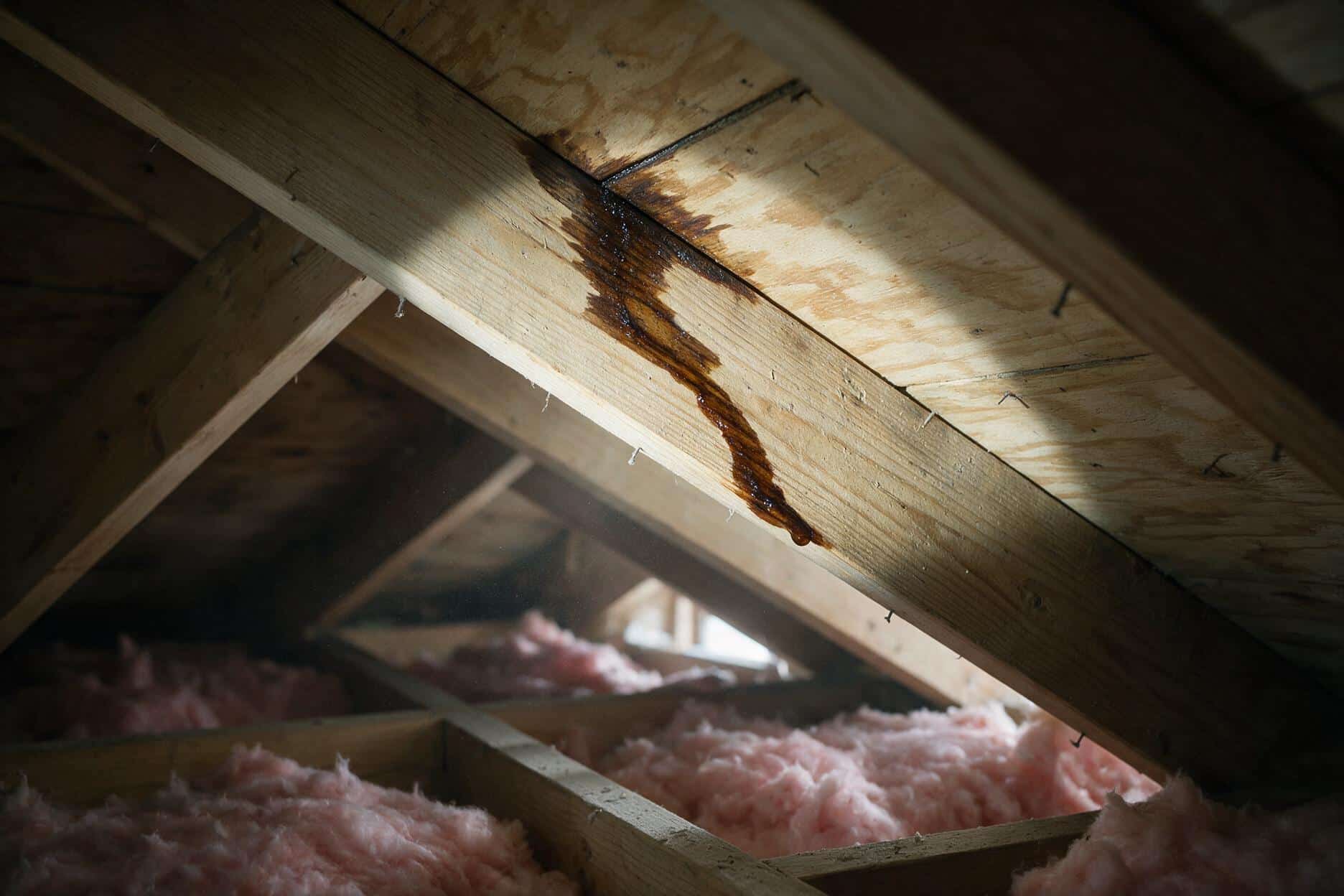
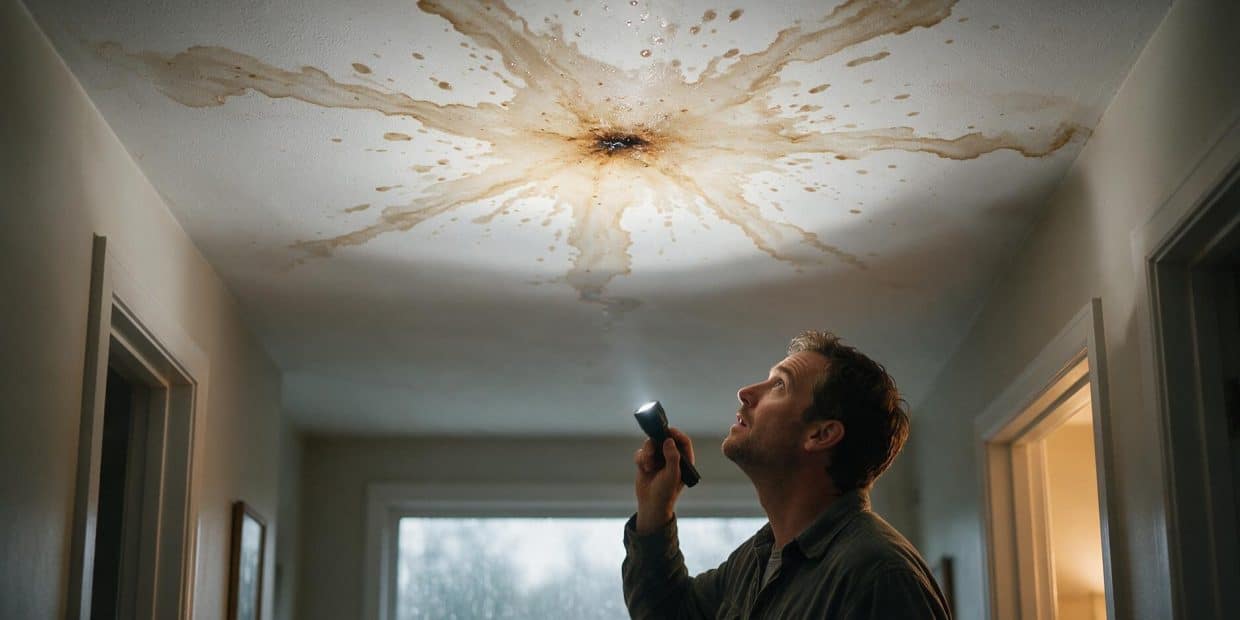
That’s why a chimney leak can show up as a stain a full room away, and why a valley leak on one side of the roof can drip near a wall on the other side of the framing bay. If you have attic access, this is the one piece of detective work worth doing before you call anyone: on a rainy day, or right after one, go up with a flashlight and follow the framing uphill from the wet insulation or the dark trail on the wood, not straight up from where the ceiling is stained. The actual entry point is very often higher and further from the stain than it looks from the room below.
This delay works in time as well as distance. Insulation above a ceiling can absorb a surprising amount of water before it’s saturated enough to show on the drywall below, and a slow drip along a rafter can take a rain cycle or two to build up a visible mark. That’s part of why acting on it matters more than the size of today’s stain: a leak that has quietly wetted a joist bay for a month leaves a much bigger repair than one caught the week it started. The EPA’s own moisture control guidance for building design and maintenance puts it plainly: water that gets in through a leaking roof should be removed and dried out immediately, not left to sit until the next dry spell.
Trace it by where the stain sits
Once you know the water is traveling before it drops, location on the ceiling stops being a precise map and becomes more of a general direction. Even so, where the stain sits relative to the rest of the house narrows the list of suspects considerably. This is the same logic I use on a first site visit, before a single shingle gets checked.
| Where the stain is | What it usually points to | Who fixes the source |
|---|---|---|
| Top-story ceiling, near an exterior wall or a chimney chase | Wall or chimney flashing | Roofer |
| Directly below a roof-to-wall step, dormer, or where two rooflines meet | Step flashing or a roof valley | Roofer |
| Along the outside edge of the ceiling, near the eaves | Clogged gutter backing water up under the shingle edge, or an ice dam in winter | Gutter cleaning, roofer, or insulation contractor |
| Centered under a bathroom or kitchen exhaust cap on the roof | Vent boot or exhaust cap flashing | Roofer |
| Around a skylight or roof window | Skylight seal or flashing | Roofer, sometimes the skylight manufacturer for a warranty seal |
| Random-looking spot with no nearby exterior wall, worse on windy storms | Wind-driven rain finding a lifted shingle tab or nail pop | Roofer |
| Same general spot, but shows up on cold, calm days with no rain at all | Not rain. See the condensation section below | HVAC technician |
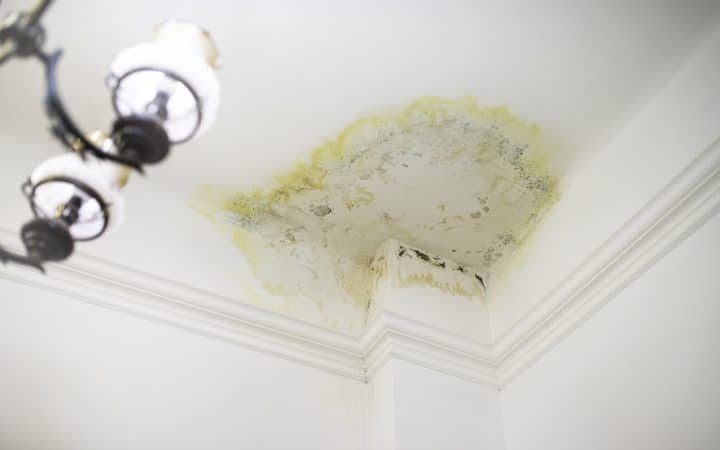
This table gets you to the right trade faster, but it doesn’t replace reading the stain itself: its shape, how the edge is aging, whether it’s still active. Our guide to water stain on ceiling covers that reading in more depth, including how to tell an old, closed-out stain from one that’s still being fed.
The six places rain actually gets in
Almost every rain-triggered ceiling leak I’ve traced comes back to one of six places. None of them is the open field of shingles in the middle of a roof slope; that part sheds water fine when it’s intact. It’s always a seam, a penetration, or a place where water is meant to be redirected and isn’t.
Roof and chimney flashing
Flashing is the thin metal that seals the joint anywhere a roof meets something vertical: a chimney, a sidewall, a dormer. It’s the single most common source of a rain-only ceiling leak I run into, and chimneys are the worst offender because they combine three failure points in one spot: step flashing along the sides, counterflashing set into the masonry, and the cricket behind it that’s supposed to divert water around the chimney. Flashing fails from dried sealant, corroded or lifted metal, or counterflashing worked loose from its mortar joint. None of that shows from the ground. It shows as a stain near that wall on the next hard rain.
Damaged or missing shingles
A cracked, curled, or missing shingle is the most obvious cause and the easiest to confirm from the ground with binoculars after a storm: torn tabs, exposed decking, or shingles noticeably lighter and more granule-bare than the ones around them. Wind is the usual culprit, working a tab loose over several storms before it tears free. Once the shingle is gone, that section of roof is only as waterproof as the underlayment beneath it, a much shorter clock than most homeowners assume.
Clogged gutters and downspouts
A gutter packed with leaves doesn’t just overflow onto the lawn. Water backs up under the bottom row of shingles at the roof edge, works past the drip edge, and travels along the deck exactly like a flashing leak would. This is the cause people rule out first and shouldn’t, because it produces the same ceiling stain as a shingle or flashing failure, and it’s the cheapest of the six to fix. If the stain sits close to an exterior wall under a section of roof with a gutter you haven’t cleaned this year, look there before you assume you need a new roof.
Roof valleys
Wherever two roof slopes meet at an angle, water from both sides funnels into that valley, which carries far more volume than any other part of the roof during heavy rain. A shallow pitch, damaged valley underlayment, or debris sitting in the channel all turn that high-volume path into a leak point. Because a valley carries so much water, a valley leak often shows up faster and grows faster during a storm than a flashing leak does, and it’s usually one of the pricier repairs since the whole valley liner typically has to come up.
Skylights and roof windows
A skylight is a large, deliberate hole in the roof, sealed only by flashing and a gasket, both of which weather faster than the shingles around them because they sit at a seam rather than a flat run. Leaks here often only appear during wind-driven storms, since a light straight-down rain may not push water into the same gap a gusty, angled rain will. If the stain sits within a couple of feet of a skylight and the timing lines up with your windier storms specifically, start there.
Vent boots and roof penetrations
Every pipe, exhaust fan, and plumbing stack that exits through the roof needs a boot, a molded collar that seals around the pipe. Rubber boots crack with UV exposure over roughly ten to fifteen years, well before most shingle fields need replacing, which makes a cracked boot one of the most common leaks on a roof that otherwise looks sound. A stain centered under a bathroom or kitchen exhaust cap, rather than under an exterior wall, points here first.
Winter adds a seventh cause: ice dams and attic condensation
In climates that get real winter, a ceiling can leak with no active rain falling at all, and it’s still weather-driven. Warm air escaping from the living space into an under-insulated attic melts the underside of the roof’s snow load. That meltwater runs down to the cold eaves and refreezes right at the edge, building a ridge of ice. Once that dam is tall enough, meltwater behind it has nowhere to go but backward, under the shingles, and into the ceiling below, the same path a clogged gutter would take, just built out of ice instead of leaves.
The same warm, moist attic air can also condense directly on the cold underside of the roof deck with no ice dam involved at all, which is why some winter stains never seem to line up with an actual storm. The trigger there is temperature difference, not precipitation, and the fix is the same either way: air-sealing the attic floor so warm air stops leaking up, and getting insulation to the depth the climate calls for. That’s an insulation contractor’s job, not a roofer’s, even though the symptom lands on the ceiling exactly like a roof leak.
| Season | Likely location | Probable cause |
|---|---|---|
| Spring and fall, heavy rain | Anywhere near a penetration or wall | Flashing, valley, vent boot, or shingle damage |
| Summer, sudden storms | Near skylights, dormers | Wind-driven rain into a weathered seal |
| Winter, along the eaves | Outer edge of the ceiling, upstairs corners | Ice dam backup |
| Winter, no storm activity | Diffuse, no clear point source | Attic condensation from warm, moist indoor air |
| Any season, equipment overhead | Directly under an air handler or ductwork | Not weather at all. HVAC condensate, see below |
One side effect worth watching for: a house that’s been through a few ice dam seasons sometimes develops fine cracking in the ceiling drywall near the eaves, from framing moving slightly as it takes on and sheds that extra weight each winter. If you’re seeing cracks alongside the staining rather than just a stain on its own, our guide to how to fix cracks in walls covers how to tell settling from something that needs a closer look.
Is it really the rain? Ruling out condensation
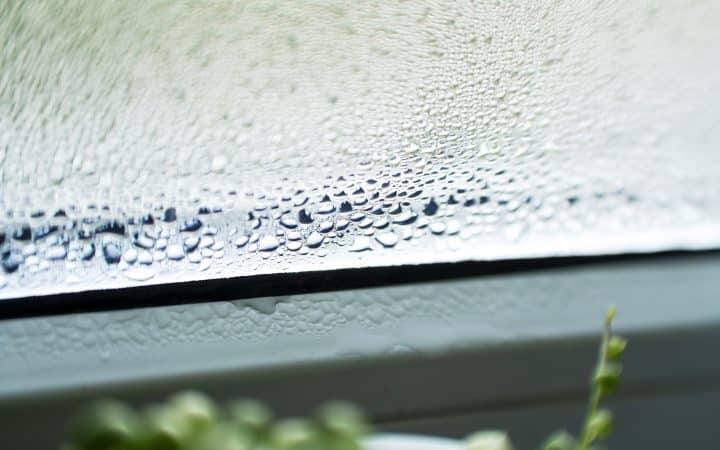
Before you call a roofer, it’s worth ten minutes to make sure rain is actually the trigger and not just the coincidence. HVAC condensation gets blamed on the roof more often than people realize, especially when an air handler or a run of ductwork sits in the attic directly above the stain. That’s a mechanical problem, not a roofing one, and it has nothing to do with the weather outside.
The two signatures rarely overlap once you look for them side by side. A rain leak tracks the storm: it appears or visibly grows during or immediately after rain, and stays exactly the same size through a dry week. Condensation tracks temperature and humidity instead, so it often shows up on the first hot, humid day when the air conditioning kicks on hard, or on a cold night with the heat running, and it can keep slowly growing during a stretch with no rain at all.
| Signature | Rain leak | HVAC condensation |
|---|---|---|
| Timing | During or right after rainfall | First hot week, or a cold snap; unrelated to precipitation |
| Pattern | Single path to one low point, often near a penetration | Broader, sometimes damp over a wider patch under the equipment |
| Behavior on a dry week | Stops growing, may lighten as it dries | Can keep growing if the clogged line or pan isn’t fixed |
| What’s usually overhead | Roof deck, chimney, or valley | An air handler, ductwork, or a mini-split line set |
A two-week log settles it for free
Mark the edge of the stain in pencil with today’s date. Check it after the next rain, and check it again after a dry stretch of similar length. If it only moved on the rainy day, it’s weather. If it grew during the dry stretch too, or grew on a hot day with no rain in the forecast, look at the equipment overhead instead of the roof.

What to do right now
If it’s actively dripping while you’re reading this, the diagnosis can wait a few minutes. Protecting the room and the ceiling itself comes first, and none of the following steps requires you to get on the roof.
Stay off the roof, and stay clear of the ceiling if it’s sagging
A wet, pitched roof in the rain is not a DIY tarp job; that’s how a bad afternoon turns into an emergency room visit. If the ceiling is bulging or sagging under the weight of trapped water, keep everyone, kids and pets included, out of that room until it’s been relieved. A soaked section of drywall can fail without much warning.
-
Kill the power to the area if water is anywhere near a fixture or outlet
Water and wiring don’t mix. If the drip is close to a ceiling light, fan, or an outlet on the wall below, switch off that circuit at the breaker before you do anything else.
-
Contain the drip
A bucket lined with an old towel cuts down splashing and gives you a rough sense of volume over time, which is useful information for whoever you call next. Move it as needed; the drip point can shift as water finds a new low spot.
-
Protect what’s underneath
Pull furniture and anything that can’t get wet out from under the stain, and cover what you can’t move with a plastic tarp or painter’s plastic.
-
Relieve a bulging ceiling deliberately, if it’s already bulging
A pocket of trapped water pushing the drywall down is more dangerous left alone than drained on purpose. With safety glasses on and the power off in that area, push a screwdriver or awl gently into the center of the bulge from below, standing to the side rather than directly underneath, and let it drain into a bucket. A small, controlled hole beats a large section giving way on its own.
-
Note the weather and the timing
Write down what the rain was doing when it started, light or heavy, wind-driven or straight down, and roughly how far into the storm the drip began. That detail is exactly what a roofer uses to narrow down which of the six causes above they’re looking for before they even get on a ladder.
Roofer, plumber, or HVAC tech: who to call first
Once the immediate mess is under control, the timing test and the location table above, plus a closer read of how the stain itself is aging, should point you toward one of three trades. Getting this order right the first time saves a wasted service call.
- Tracks with every rain, regardless of temperature: a roofer, and mention which of the six causes above seems closest so they know where to start looking before they’re on the ladder.
- Only shows in winter, along the eaves or diffuse with no clear point: a roofer or an insulation contractor, for an ice dam and attic air-sealing assessment rather than a straight leak repair.
- Shows up on hot or cold days with equipment overhead, unrelated to rain: an HVAC technician for the condensate line and drain pan.
- Ceiling actively sagging or dripping heavily, regardless of cause: a water restoration company first, the same day, to extract and dry the space before anyone diagnoses the source.
The gap between “caught early” and “ignored” is the real cost driver
A flashing or vent boot leak called in the week it starts is usually a modest, contained repair. The same leak ignored through a second or third storm has typically soaked a joist bay, ruined the insulation above the ceiling, and turned a one-trade fix into a multi-trade one. Acting on the timing test above, rather than waiting to see if it happens again, is what keeps this cheap.
What fixing the source costs in 2026
This is a diagnostic guide, not a pricing one, so treat the numbers below as the rough order of magnitude for the roof-side repair only, not a quote. Actual pricing depends on your market, roof pitch and access, and how much decking or insulation the water reached before anyone found it.
| Source repair | Typical US range, 2026 |
|---|---|
| Vent boot or pipe collar replacement | $150–$400 |
| Flashing repair (chimney, wall, or step flashing) | $300–$800 |
| Valley leak repair | $400–$1,200 |
| Gutter cleaning and minor regrading | $100–$300 |
| Ice dam removal plus attic air-sealing | $500–$2,000+ |
None of that includes the ceiling itself. Once the source is confirmed stopped and the board has actually dried, not just dried on the surface, the drywall repair is priced separately and mostly depends on whether the board stayed firm or needs to be cut out. That decision, and the full 2026 numbers for seal-and-paint versus cut-and-patch versus full replacement, is covered in water damage ceiling repair cost. If the same leak also reached a wall, drywall repair cost breaks down that side of the job, and the rest of our pricing guides live under costs.
When the ceiling itself needs attention, not just the roof
Stopping the source is step one, not the whole job. What the water left behind on its way through matters just as much, and it’s a purely structural, material question, not a health one, which is outside what this article covers. A ceiling that took on water shows it a few predictable ways: a ring-shaped stain that keeps its shape once dry, paint that’s bubbled or cratered where the water sat longest, a seam that’s lifted and stayed lifted, or in the worst cases, a section that sags between the joists even after everything has dried out.
Firmness under light thumb pressure decides whether that section gets a stain-blocking primer or gets cut out, not how bad the stain looks. If it’s still rigid and flat, it’s often a cosmetic fix once the source is dead. If it’s gone soft, spongy, or the paper is lifting off the gypsum, that section isn’t coming back and needs to be cut out to the nearest joists, a job covered step by step in how to patch a large hole in drywall, and repainted following the wet-edge technique in painting walls so the patch doesn’t flash under a light fixture.
If the ceiling has a sprayed or troweled texture and the house was built, or last had that ceiling applied, before 1980, stop before scraping or cutting into it. Get it lab tested first; the process and what a positive result changes are covered in popcorn ceiling asbestos. Assuming it tests clear, drywall texture types helps identify what’s up there before you buy the wrong aerosol can, and a smooth ceiling that needs re-leveling after a patch is a skim coat question rather than a texture-match one.
Water sitting in a ceiling cavity for any length of time is also the one condition that lets mold get established on the wet paper facing, a musty smell right at the stain being the material tell. That’s a problem for the board, not something this site covers from a health angle (see our disclaimer for exactly where our advice stops). If the growth is larger than a small patch, or you can’t find where the water came from, the diagnostic sequence in how to detect mold inside walls walks through confirming it without cutting the ceiling open blind, and how to get rid of mold on walls covers the line between a homeowner-level cleanup and a job for a certified remediation contractor.
Questions I get on site
How long after rain starts does a ceiling leak usually show up?
Anywhere from a few minutes into a storm to a day or two later, depending on how much insulation and framing the water has to soak through first. A direct path shows fast. A slower path, where water tracks along a rafter or pools on the attic floor before it saturates the ceiling from above, can lag well behind the rain itself, which is exactly why the stain and the leak point are so often in different places, a pattern our water stain on ceiling guide walks through in more depth.
Could it be condensation instead of an actual roof leak?
Yes, especially if there’s an air handler, ductwork, or a mini-split line set in the attic directly above the stain, and the timing lines up with hot or cold snaps rather than rainstorms. Run the pencil-mark test in the condensation section above for two weeks before you assume it’s the roof.
How much does it cost to fix a roof leak causing a ceiling stain?
Most single-cause source repairs, a vent boot, a section of flashing, a gutter cleaning, land between $150 and $1,200 in 2026, before the ceiling drywall itself is touched. A valley or an ice dam situation runs higher. The full breakdown of what the ceiling repair adds on top is in water damage ceiling repair cost.
Do I need a roofer or a plumber for a ceiling leak?
If it tracks with rain, it’s a roofer’s question almost every time, since the six causes covered above are all roof-side. A plumber gets the call when the stain sits under a bathroom, kitchen, or laundry room and shows up regardless of the weather, which points at a supply line or fixture instead.
Is a popcorn ceiling leak a different job than a smooth one?
The source repair on the roof is identical. What changes is the ceiling-side work if the texture predates 1980: it needs lab testing before anyone scrapes, sands, or cuts into it, a process covered in popcorn ceiling asbestos. Popcorn ceiling removal cost covers what that split does to the price once testing is done.
Does a ceiling leak always mean mold?
No, not if the source gets fixed and the board dries out within a couple of days. Mold needs sustained moisture to establish, so a quick catch rarely gives it that chance. A leak that ran for weeks before anyone noticed is a different story. How to detect mold inside walls covers the non-destructive way to check a cavity, and how to get rid of mold on walls covers where a homeowner cleanup ends and a professional job begins.
Can I just repaint over the stain once the leak is fixed?
Only once the board is confirmed dry and firm, and only with a stain-blocking primer rather than ordinary ceiling paint, which will let the old stain bleed straight back through. Painting walls covers the wet-edge technique that keeps a ceiling repaint from flashing under a light fixture, the same principle that applies overhead.
Can a ceiling leak cause cracking, not just a stain?
Yes, especially after repeated freeze-thaw seasons near the eaves, where framing takes on and sheds moisture repeatedly. If you’re seeing hairline cracks alongside a stain rather than just discoloration, how to fix cracks in walls covers how to tell normal settling from something that needs a closer look.
Everything above is meant to get you to the right trade with the right information, not to replace an in-person inspection. Roof pitch, attic access, and your local storm pattern all change the specifics, and a licensed roofer or restoration contractor should confirm the exact cause before any repair starts. Figures are US ranges current as of August 2026. If something here doesn’t match what you’re seeing on your own ceiling, tell me about it and I’ll take a look. More on how I work is on the about page, and the rest of this section lives under moisture and mold.