There is no single popcorn ceiling removal cost, and anyone who gives you one number has skipped the question that decides everything. The texture either contains asbestos or it does not. That one lab result moves the same 144 square foot bedroom ceiling from roughly $400 to roughly $1,200, and it changes who is allowed to touch it.
So here are both numbers up front. A clean, unpainted popcorn ceiling costs $1 to $3 per square foot to scrape in 2026. A ceiling that tests positive costs $5 to $12 per square foot to have removed by a licensed abatement contractor, and quotes hit $20 in tight urban markets where disposal is a headache. The national average project lands near $2,000, with most homeowners paying somewhere between $930 and $3,080.
I have measured a lot of ceilings. What surprises people is not the asbestos premium, which everyone half expects. It is that the scraping itself is the cheap part of a clean job, and almost nobody quotes the part that costs the money. I will get to that in the second section.
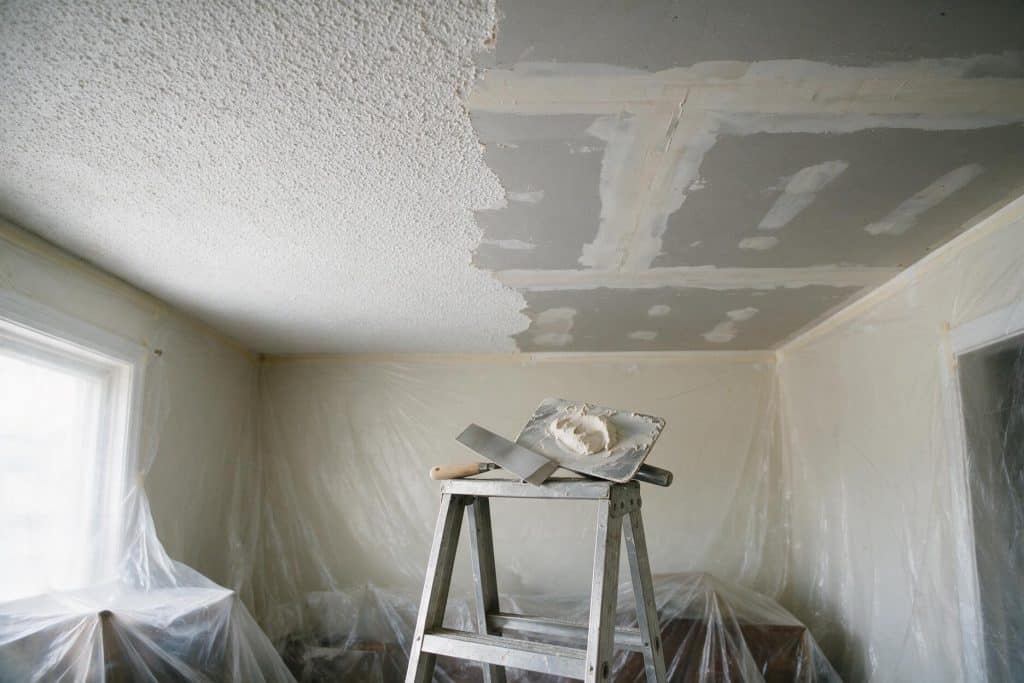
What popcorn ceiling removal cost actually covers in 2026
The phrase “removal” gets used for four different scopes of work, priced very differently. When you compare two quotes and one is half the other, this table is usually why.
| Scope | What you get | Per sq ft |
|---|---|---|
| Scrape and haul | Texture off, debris out, bare ceiling with visible joints | $1.00 to $3.00 |
| Scrape and patch | Above, plus gouges filled and joints touched up | $1.75 to $3.75 |
| Scrape, skim, prime, paint | Finished ceiling ready to live under | $2.50 to $7.00 |
| Licensed asbestos abatement | Containment, negative air, HEPA, sealed disposal, clearance | $5.00 to $12.00 |
Most homeowners who say they want the popcorn gone are describing row three and pricing row one. That gap is the single most common reason a job goes over budget in this niche.
The line nobody puts on the quote
Popcorn texture was not decorative. It was a production shortcut. Spraying acoustic texture let a builder stop finishing the drywall two or three levels early, because the texture hid everything underneath. That is why it went on so many ceilings so fast between the 1950s and the 1980s.
The US finishing standard, GA-214, runs from Level 0 to Level 5. Level 1 is tape embedded in compound, tool marks and ridges allowed. Level 4 is smooth enough for flat paint. Level 5 is a thin skim coat over the whole surface, and it is what you need anywhere light hits the surface at a shallow angle.
Scrape a popcorn ceiling and you usually expose a Level 1 or Level 2 ceiling. Ridged tape lines. Screw heads with a single coat over them. Butt joints that stand proud. Now put a window on one wall and a fixture in the middle, and every one of those defects throws a shadow across the whole room. Ceilings are the worst surface in a house for raking light, which is exactly why they need the best finish level.
Scraping is about 30% of a finished ceiling
On a $1,100 finished bedroom ceiling, the scrape is roughly $300. Skim coat, sanding, primer and two coats of ceiling paint are the other $800. When a quote looks cheap, check which of those two jobs it is describing.
Ask any contractor quoting your ceiling which GA-214 level they are leaving you at. Most will answer honestly and some will be impressed you asked. The ones who cannot answer are the ones whose quote is missing $800.
Popcorn ceiling removal cost without asbestos
This is the clean path: house built after 1990, or tested and negative. Figures below are ceiling area, not floor area, which for a flat ceiling is the same number.
| Room | Ceiling sq ft | DIY materials | Pro, scrape only | Pro, finished and painted |
|---|---|---|---|---|
| Small bedroom 10 × 12 | 120 | $60 to $150 | minimum charge, $350 to $600 | $400 to $850 |
| Bedroom 12 × 12 | 144 | $70 to $180 | $350 to $600 | $450 to $1,000 |
| Living room 12 × 16 | 192 | $95 to $240 | $350 to $650 | $550 to $1,350 |
| Great room 15 × 20 | 300 | $150 to $375 | $400 to $900 | $800 to $2,100 |
| Whole house | 1,600 | $200 to $500 | $1,900 to $4,000 | $4,000 to $9,000 |
Look at the first two rows. Per square foot, a 120 sq ft ceiling should cost less than a 144 sq ft ceiling, and it does not. Below roughly 200 square feet the per square foot rate stops meaning anything, because you are paying for a crew to show up, mask a room, and come back to sand. That is the same trip charge effect I wrote about in the drywall repair cost guide, and it is why doing one ceiling at a time is the most expensive way to do a whole house.
Two ceilings in the same visit rarely cost twice one ceiling. Ask for the price of the whole floor before you decide to start with the bedroom.
Popcorn ceiling removal cost when the test comes back positive
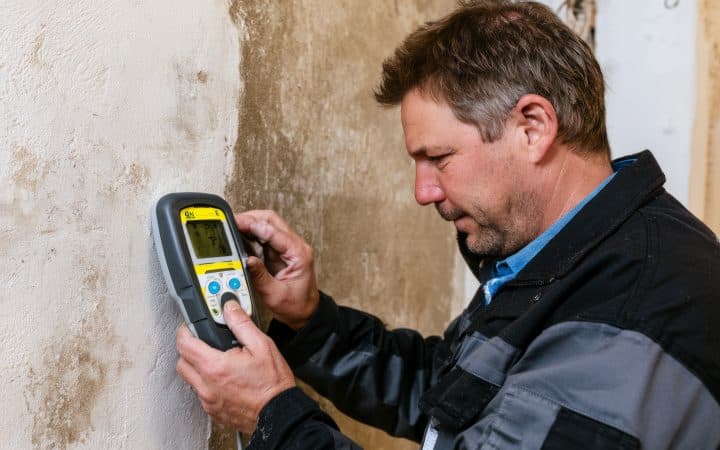
A mail-in lab sample costs $30 to $60. An inspector who comes out, samples several areas and writes a report costs $250 to $800. Either way, testing is the cheapest decision in this whole article, and it is the one that sets the price of everything after it. If your texture went up before the mid 1980s, test it. The full picture of dates, thresholds and what triggers a test is in the popcorn ceiling asbestos guide.
Positive result, three legal options, priced here for the same 144 sq ft bedroom and a 1,600 sq ft house.
| Option | Per sq ft | 144 sq ft room | 1,600 sq ft house |
|---|---|---|---|
| Licensed abatement, then finish | $5 to $12 | $1,000 to $1,900 | $8,000 to $19,000 |
| Encapsulation, sealed and painted | $2 to $6 | $450 to $900 | $3,200 to $9,600 |
| Drywall overlay, finished and painted | $3 to $6 | $550 to $1,000 | $4,800 to $9,600 |
Abatement rooms carry a minimum too, usually $1,500 to $2,500, because containment and clearance testing cost the same whether the room is small or large. On one room, the minimum is often the price.
There is no cheap version of removing asbestos texture
If the lab says positive, scraping it yourself is not a budget option. It is the one path that turns a $900 problem into a contaminated house. Wet scraping does not make it safe, and a shop vacuum makes it worse. Get a licensed abatement contractor, or leave the texture in place and cover it.
Nothing here is a work method for asbestos-containing material. Please read our disclaimer before you plan any of this.
Where the money actually goes on a clean scrape
Here is a real split from a 300 sq ft great room, scraped and finished to Level 5, quoted at $1,650.
| Line | Share | Amount |
|---|---|---|
| Labor, scraping | 19% | $310 |
| Labor, skim coat and sanding | 42% | $695 |
| Labor, prime and two coats | 19% | $310 |
| Materials | 9% | $150 |
| Masking, protection, cleanup | 7% | $115 |
| Trip and setup | 4% | $70 |
Materials are 9% of that bill. Compound, primer, paint, tape, plastic. You cannot save money by buying better mud, and you cannot save money by supplying the paint. Eighty percent of what you are paying for is somebody standing on stilts with their arms above their head, and the skim coat is by far the largest single line.
This is also why the DIY saving is real but lopsided. You are not saving on materials. You are trading four evenings of the worst work in the trade for about $1,100.
What pushes your quote up
Six things move a popcorn quote, roughly in order of how much they matter.
- Painted texture. Paint seals the popcorn so water cannot soak in. Wet scraping stops working and the crew has to dry scrape or sand it off, which is slower and much dirtier. Add 40% to 100% to the scrape line.
- Ceiling height. Anything over 9 feet means stilts stop working and staging goes up. Vaulted and cathedral ceilings add 25% to 50%.
- Occupied house. Masking a furnished room, working around your schedule, cleaning to a standard you can live in that night. Empty house rates are noticeably lower.
- Finish level. Covered above. Level 4 to Level 5 is the biggest single upgrade you can decline, and on a ceiling I would not decline it.
- Water staining. Stains under the texture mean a leak, and a leak means the ceiling may need patching before it needs finishing. See the moisture and mold section before you book anyone.
- Access. Third floor walk-up, no driveway, small elevator. Disposal is bulky and this shows up in the price.
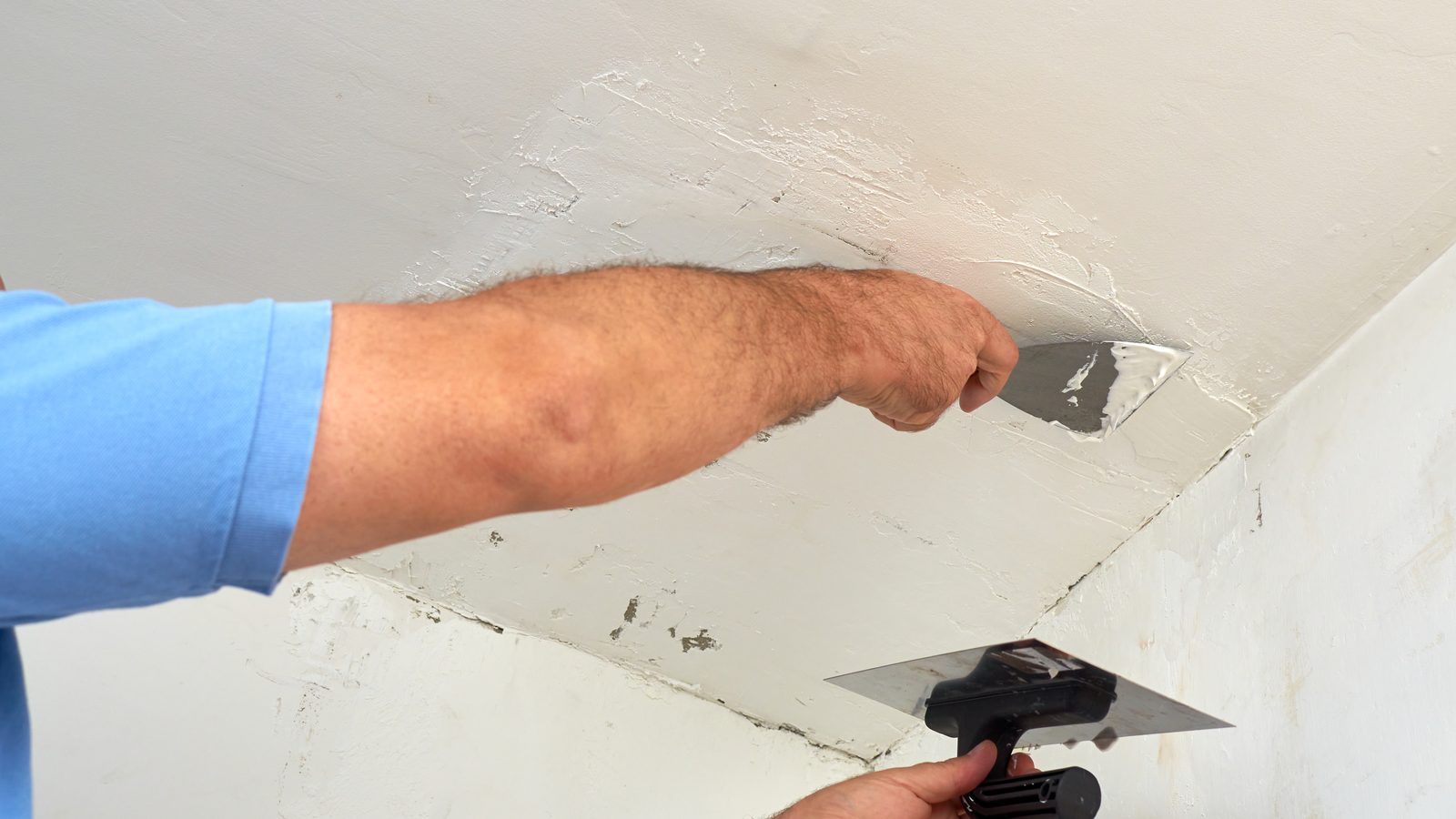
Doing it yourself: what you save and what you take on
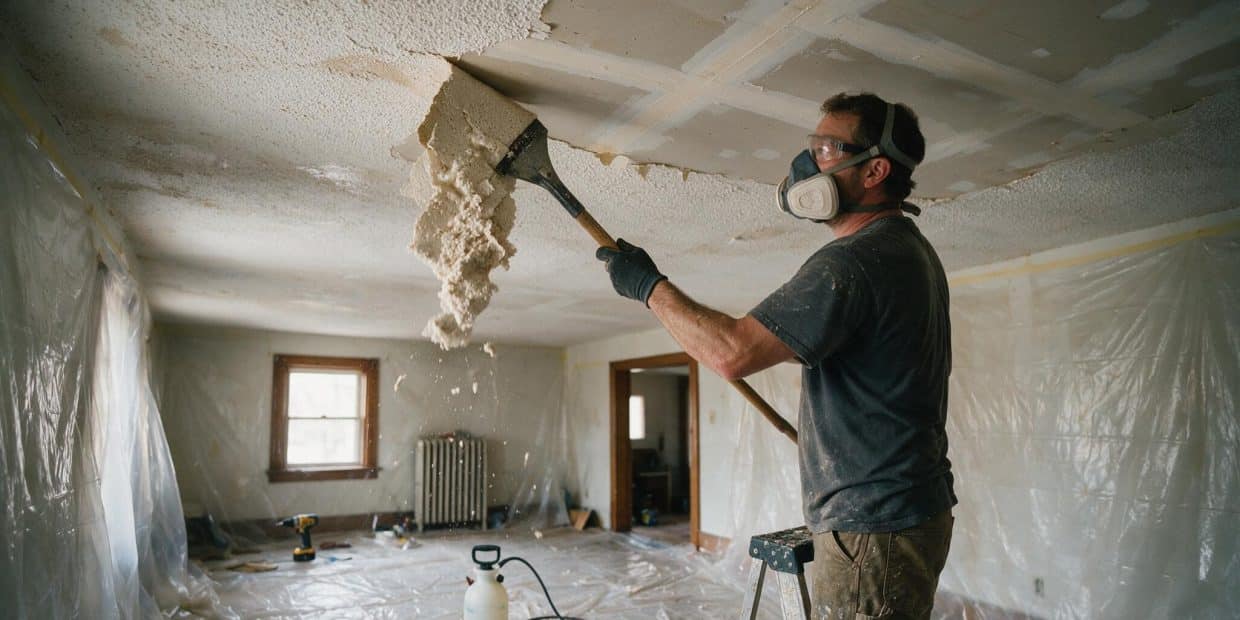
Materials for DIY run $0.50 to $1.25 per square foot, or $200 to $500 for a whole house. A ceiling scraper with a bag attachment is $15 to $30. A pump sprayer is $20. You will also want a respirator, eye protection you can actually see through when it is covered in wet compound, and more plastic sheeting than you think.
The scraping is easy and unpleasant. Anyone can do it. The skim coat is neither, and it is where DIY ceilings go wrong. A ceiling skim coat is a genuinely difficult finishing job, done overhead, on a surface that shows every flaw. If you have never skimmed a wall, do not learn on a ceiling in your living room.
The split job is the best value in this whole article
Scrape it yourself, then pay a finisher for the skim and paint. You keep the $300 of labor that needs no skill and buy the $700 that does. Get the finisher to look at the bare ceiling before you scrape, so they price the job they will actually get.
How to price your own ceiling in six steps
-
Measure the ceiling, not the floor plan
Length times width per room, added up. On a vaulted ceiling, measure the slope with a tape run up the rake, not the flat dimension below it. People underestimate vaulted ceilings by 20% or more.
-
Find out how old the texture is
Not the house, the texture. A 1996 house can have 1996 popcorn, and a 1962 house can have popcorn from a 1984 remodel. Permits, listing photos and the previous owner all help. Anything that might predate the late 1980s gets tested.
-
Test before you price anything
$30 to $60 for a mail-in sample, five to ten days for the result. Every number below this line changes depending on that report, so there is no point pricing the job first.
-
Check whether it has been painted
Spray a hidden patch with water and wait fifteen minutes. If it softens and comes off with a putty knife, it is unpainted. If it stays hard, it is sealed, and your scrape line just went up 40% or more.
-
Decide your finish level before you call anyone
Level 4 for a low-light hallway, Level 5 anywhere a window or a fixture rakes across the surface. Write it into your request for quotes so every contractor prices the same job.
-
Get three quotes, all for the same scope
Same rooms, same finish level, same question about who handles disposal. If one quote comes in far below the other two, it is almost always missing the skim coat.
Covering the ceiling instead of scraping it
Quarter inch drywall screwed through the old ceiling into the joists, then taped and finished, runs $1.50 to $3 per square foot for the hanging and $3 to $6 finished and painted. On a clean ceiling that is roughly the same money as scraping and finishing, so it comes down to mess and downtime rather than price.
On a ceiling that tested positive, the arithmetic changes completely. Overlay at $3 to $6 against abatement at $5 to $12, and the overlay leaves the asbestos undisturbed and encapsulated behind a new surface, which is a recognized management strategy rather than a dodge.
The catch is honest and worth knowing. You lose half an inch of ceiling height, your crown molding and light fixtures need resetting, and the asbestos is still up there. You will have to disclose it when you sell, and any future renovation that opens that ceiling starts the same conversation again. I still think it is the right call more often than the industry admits, and the reason it gets recommended so rarely is that the people you ask are abatement contractors.
How to read a popcorn ceiling removal cost quote
A quote you can actually compare has these lines on it. If yours has one number and one sentence, ask for them.
- Square footage the contractor measured, room by room
- Whether the texture has been tested, and by whom
- The GA-214 finish level being delivered
- Primer and paint included or excluded, and how many coats
- Who masks, who cleans, who hauls the debris
- What happens if water damage turns up under the texture
That last line has saved more of my clients money than anything else on the list. Popcorn hides stains, and stains mean the ceiling has a history. Agreeing the change order rate in advance beats negotiating it with a crew standing in your living room.
Questions I get on site
What is the popcorn ceiling removal cost per square foot?
$1 to $3 for the scrape, $2.50 to $7 for scrape through paint, $5 to $12 for licensed abatement. The rate only behaves sensibly above about 300 square feet. Under that, the minimum charge and the setup time dominate, and quoting per square foot tells you nothing useful.
Are the online calculators any good?
They are fine for an order of magnitude and useless for a decision, because almost none of them ask the two questions that matter: has it been tested, and what finish level do you want. A calculator that returns a number before asking about asbestos is guessing.
What does asbestos popcorn ceiling removal cost on top of a normal job?
Roughly three to four times. A clean 1,600 sq ft house at $2 per square foot is about $3,200. The same house abated sits between $8,000 and $19,000, and you still owe the finishing afterward, because abatement leaves you a bare ceiling and nothing more.
Does removing it add value to the house?
It shortens time on market more reliably than it raises the price. Buyers read popcorn as deferred maintenance and as an asbestos question they will have to answer later. A clean flat ceiling removes both objections. I would not budget it as an investment, but I would do it before listing.
Can I just paint over it?
You can, and it is $0.75 to $1.50 per square foot. It also permanently ends the option of wet scraping, because paint seals the texture. Painting a popcorn ceiling you intend to remove later is the one move in this article I would call a mistake.
What I would do
Test first, always, and price nothing until the report comes back. If it is negative, scrape it yourself over a weekend and hire the skim coat and paint out. If it is positive, get one abatement quote and one overlay quote, and read them side by side without assuming the abatement is the responsible choice and the overlay is the cheap one.
The number that ends up on your invoice has far more to do with what is under the texture than with the texture itself. Nobody selling ceiling work has much reason to tell you that, which is roughly why this site exists. If you want to know more about how I price this work, there is a bit about that on the about page, and the rest of the costs section covers the neighboring jobs.
Got a ceiling and a quote you are not sure about? Send it over through the contact page with a photo and the year the house was built. I read them all.