Nobody calls me about a water stain on ceiling drywall the day it appears. They call three weeks later, after the ring stopped growing, and they ask for a price to paint over it. That call is the one that costs people money.
The stain is not the problem. The stain is the receipt. Something upstairs let go, water traveled along a joist or a pipe, found the low point in your ceiling, and left a mark where it finally dripped through. Paint over that without answering why, and you will be looking at the same ring next spring, except the gypsum behind it will be softer.
I have priced this repair for a living since 1997. Below is the order I work in on site: find it, prove it stopped, decide whether the board stays, then seal. Skipping straight to step four is the most common mistake I see, and it is the expensive one.
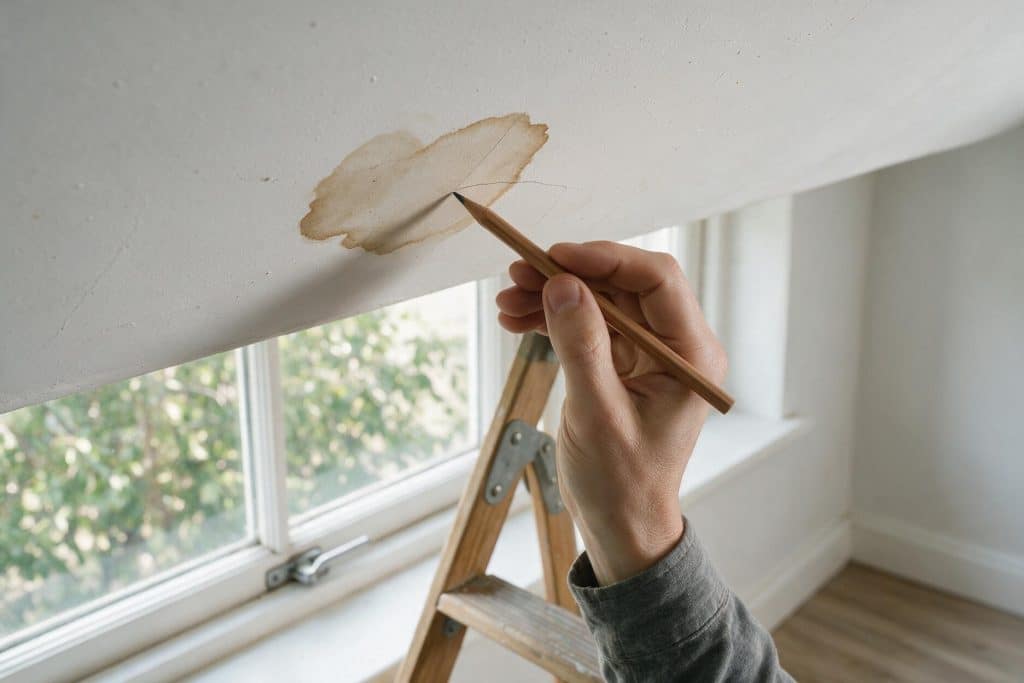
What a water stain on ceiling drywall is actually made of
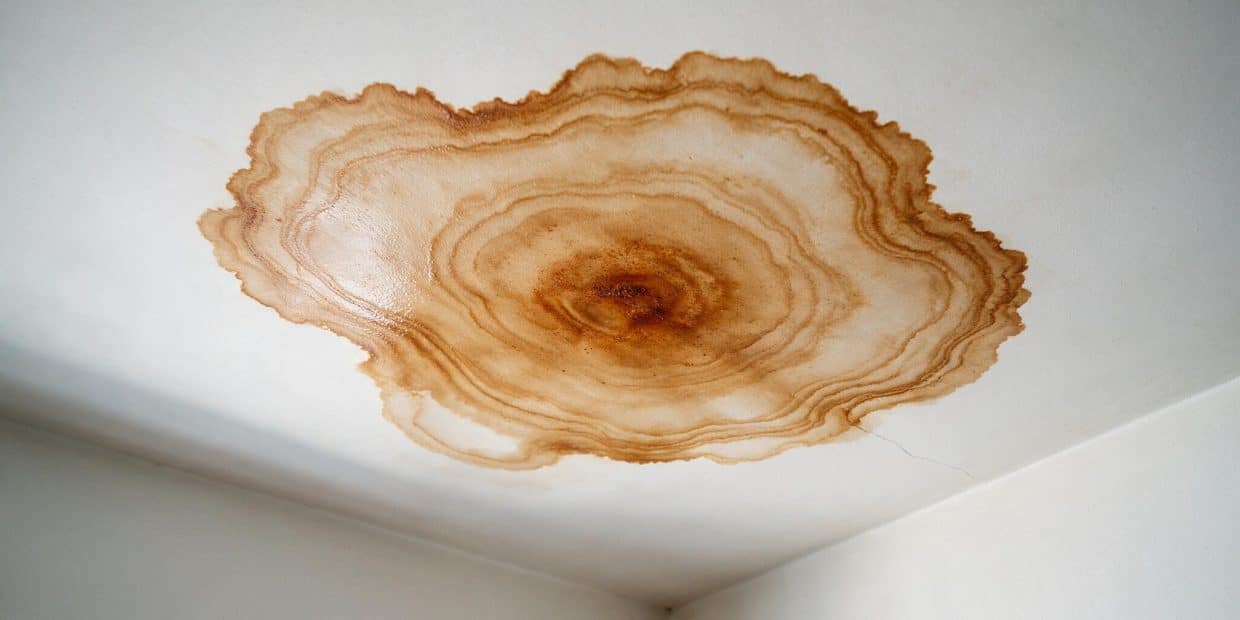
The brown is not dirt. Water moving through building materials picks up tannins from wood framing, glue and paper fiber from the drywall itself, and whatever was sitting in the cavity: rust off a nail plate, dust, old insulation binder. As the water evaporates at the surface, it leaves that load behind in a ring.
Two useful things fall out of that. First, the ring marks the edge of the wet area, not the center, which is why the darkest line sits at the outside. Second, the stain is water soluble, so ordinary latex paint will pull it straight back through the new coat within a day or two. That single fact is why half the ceilings I get called back to look at have three coats of white on them and a brown circle showing through all three.
Read the stain before you climb anywhere
Five minutes with a flashlight standing on the floor will narrow the cause more than an hour of poking at things.
| What you see | What it usually means |
|---|---|
| Yellow to light brown, soft feathered edge | Slow drip, clean water. Usually a supply line, a condensate line, or an old roof leak that has been going a while |
| Dark brown or gray, hard irregular edge | Water that has traveled through dirty material. Typical of roof and attic paths |
| Rust colored center | Water sat on a fastener or a steel plate. Points at plumbing hardware or a nail plate above |
| Several small rings in a line | Water running along a joist and dripping off successive fasteners. The source is uphill of the first ring, sometimes by ten feet |
| Stain with a fuzzy black or green bloom | Treat as mold, not as a stain. Stop and read the section below |
| Bubbled or lifted paint, no color yet | Very recent. The water is still in the paint film. This one is worth catching today |
Then the question that settles most jobs: does it change when it rains? Mark the outline in pencil, write the date next to it, and wait for weather. A stain that grows during or just after rain is a roof or flashing problem. A stain that grows on a dry week in July is plumbing, HVAC, or condensation. That pencil line has saved more roofs from being needlessly torn up than anything else I do.
Pencil, not tape
Draw the outline directly on the ceiling in soft pencil and date it. Tape falls off damp paint and takes the surface with it, and you will be priming the whole ceiling anyway when this is over.
Roof, plumbing, HVAC or condensation
Four candidates, and they behave differently enough that you can usually name yours without opening the ceiling.
Roof or flashing
Top floor only, and tied to rain. Go into the attic with a light while it is still wet and look at the underside of the sheathing rather than the insulation. Water leaves a dark trail on plywood that stays visible long after it dries. Follow it uphill. The entry point is almost never above the stain, because water runs down the slope of the rafter before it drops.
Nine times out of ten it is a penetration, not the field of the roof: a vent boot with a cracked rubber collar, a chimney counterflashing, a valley, or a nail that backed out. Ice damming does the same thing in cold climates and shows up as stains along the outside wall line rather than mid room.
Plumbing
Any floor with living space above it. Stand the stain up against the floor plan of the floor above and see what is directly over it, then within about ten feet uphill of it. Bath, shower pan, toilet flange, washing machine, dishwasher, a supply line in a joist bay.
Test it deliberately rather than waiting. Run the shower for fifteen minutes with the door shut, dry the floor completely, and check. Then do the same with someone standing in the tub, because a shower pan or a tile joint that is fine when empty will move under two hundred pounds and open up. Flush the toilet a dozen times. A wax ring that has failed leaks only during the flush, which is exactly why nobody finds it by looking.
HVAC
Summer only, or the first hard week of air conditioning. An air handler in an attic makes gallons of condensate a day and sends it out through a small drain line that clogs with algae. When the primary line blocks, the secondary pan overflows, and the stain lands under the unit or along the duct run. If your stain appeared in August and there is equipment above it, start there before you call a roofer.
Condensation
The one people diagnose last and should diagnose first in a bathroom. No leak at all: warm wet air hits a cold surface, usually where insulation is thin or missing, and the moisture drops out on the ceiling. Bathrooms with no fan, or a fan ducted into the attic instead of outside, do this reliably. So do uninsulated recessed lights, which sit like cold spots in a warm ceiling. The tell is a stain with no defined source, often diffuse, that gets worse in winter.
When a water stain on ceiling drywall becomes an emergency
A flat brown ring is a Saturday job. A ceiling that is sagging, bulging, or shining wet is not, and the difference matters that same day.
Half inch drywall holds a surprising amount of water before it gives, and when it goes it goes all at once, usually with the insulation on top of it. A bulge the size of a dinner plate is holding a few pounds. A sag that runs across a whole joist bay is holding a lot more than that, and I would not stand under it.
What I do: get everything valuable and everyone out from under it. For a small localized bulge with a clear source I will put a bucket underneath, wear glasses, stand to the side and put a single small hole in the low point with a screwdriver to let it drain in a controlled way. Draining is safer than waiting, because the weight only goes one direction. But if the sag is wide, if the ceiling is textured and the house is old, or if you cannot tell where the water is coming from, that is a call to a restoration contractor, not a DIY moment. Our disclaimer covers where my advice stops, and this is one of those places.
Textured ceiling in a house built before 1980? Test before anything else
Sprayed and troweled ceiling textures applied before the US restrictions of 1977 and 1978 can contain asbestos, and stock kept being used into the mid 1980s. Wet or not, do not scrape it, sand it, or cut into it to see how bad the damage is. A lab sample costs around $40 and it decides whether this is a $600 repair or a job for a licensed abatement contractor. The full picture is in our guide to popcorn ceiling asbestos.
Second line: if the wet area is bigger than about 10 sq ft and smells musty, the EPA treats that as past the scale a homeowner should handle. Read moisture and mold before you open the ceiling.
Is it still leaking? Prove it before you seal
You cannot tell by touch. A ceiling can read bone dry on the painted face and hold 30 percent moisture in the gypsum an inch away, because the paint film seals the surface and slows evaporation from below.
Two things settle it. The pencil outline plus a full weather cycle, or one rain if you can wait for one. And a pin moisture meter, which costs $25 to $40 and pays for itself the first time it stops you priming over a live leak. Push the pins through the paint at the center of the stain. Under about 12 percent on gypsum and you are clear to work. Above 16 and something is still feeding it.
Give it time as well. A joist bay that got soaked does not dry in a day even after the leak is fixed, especially with insulation on top of it holding the water against the board. I want 48 to 72 hours of moving air minimum, and longer in a humid house.
-
Fix the leak and confirm the fix
Run the fixture again, or wait out one full rain cycle. A stain that grows after your repair means you found a drip, not the source.
-
Open access if you can reach it
From the attic or the floor above, pull the insulation back off the wet area. Wet fiberglass never dries in place and it holds the water against the ceiling. Bag it and replace it.
-
Move air across it for 48 to 72 hours
A box fan on low aimed at the ceiling from the side, not straight up at it. Straight on air dries the paint film first and traps the rest underneath. A dehumidifier in the room does more than the fan does.
-
Meter it, do not guess
Pin meter under 12 percent on the gypsum. If you do not own one, borrow one. Priming a wet ceiling traps the moisture and the primer lifts within a month.
-
Press the board with your thumb
Dry and firm, it stays. Soft, spongy, or the paper delaminates under light pressure, the board is finished and it comes out. No primer fixes structure.
Mold, and the line I will not cross
Mold needs about 24 to 72 hours of wet material to get started, so a stain that has been there a month has had the opportunity whether or not you can see anything. What you can see on the painted face is the least of it, because the growth is on the paper backing and in the cavity.
The number worth knowing is the EPA guidance of roughly 10 sq ft, about a 3 ft by 3 ft area. Below that a homeowner can reasonably handle it. Above it, or in an HVAC system, or where you cannot identify the water source, the guidance is to bring in a professional. Remediation runs $10 to $30 per square foot once containment gets involved, which is a large part of why a slow leak found late costs several times what the same leak costs found early.
I am an estimator, not a certified remediator, and I do not write about what mold does to people. That is on my about page in plain terms. What I will tell you is the building side: if the board is soft and it smells, sealing over it is not a repair, it is a delay with a fresh coat of paint on it.
Does the drywall stay or come out?
This is the whole cost decision and it takes about ten seconds to make once the ceiling is dry.
| Condition of the board | What it needs |
|---|---|
| Stained, firm, flat, paper intact | Seal and repaint. The board is fine |
| Stained with a slight texture change, still firm | Seal, skim the area, repaint |
| Soft under thumb pressure, or paper lifting | Cut it out back to the nearest joists |
| Sagging between joists, even after drying | Cut out. It has lost its strength and it will not come back |
| Visible growth on the face, or musty smell at the ceiling | Cut out, and follow the 10 sq ft rule on who does it |
| Joint tape lifting along the seam | Board can often stay. Tape comes off and gets replaced |
One thing worth saying out loud: a dry, firm, stained ceiling is genuinely fine. Water passed through it and left a mark. People replace ceilings they did not need to replace because a brown ring looks like damage, and cosmetically it is, but structurally that board will outlive the paint on it.
What it costs to fix a water stain on ceiling drywall
US ranges as of August 2026, for the ceiling work only. Fixing the leak itself is a separate trade and a separate bill.
| Job | DIY materials | Typical quote |
|---|---|---|
| Seal and spot paint one stain | $25–$40 | $150–$350 |
| Seal and repaint the full ceiling | $60–$120 | $250–$600 |
| Cut out and replace a small section, finished | $45–$80 | $350–$800 |
| Replace a section, stain block, texture match | $70–$130 | $600–$1,600 |
| Whole ceiling replaced in an average room | — | $1,200–$3,500 |
| Mold remediation, per sq ft, with containment | — | $10–$30 |
| Lab test on a textured ceiling before work | — | $30–$60 |
Most of what people actually pay lands between $500 and $2,500 once the plumber or roofer is included. The gap between the top and bottom of that is almost never the size of the stain. It is whether the board came out, whether mold was found, and whether the ceiling has a texture that has to be matched. Our drywall repair cost breakdown splits the labor, materials and trip charge if you want to see where the number comes from.
The $28 version and the $1,600 version are the same repair caught at different times
A stain sealed the month it appears is a quart of primer and an afternoon. The same leak found two years later has soaked the joist bay, ruined the insulation, and brought a remediation quote with it. Speed is the only lever on this job that costs nothing.
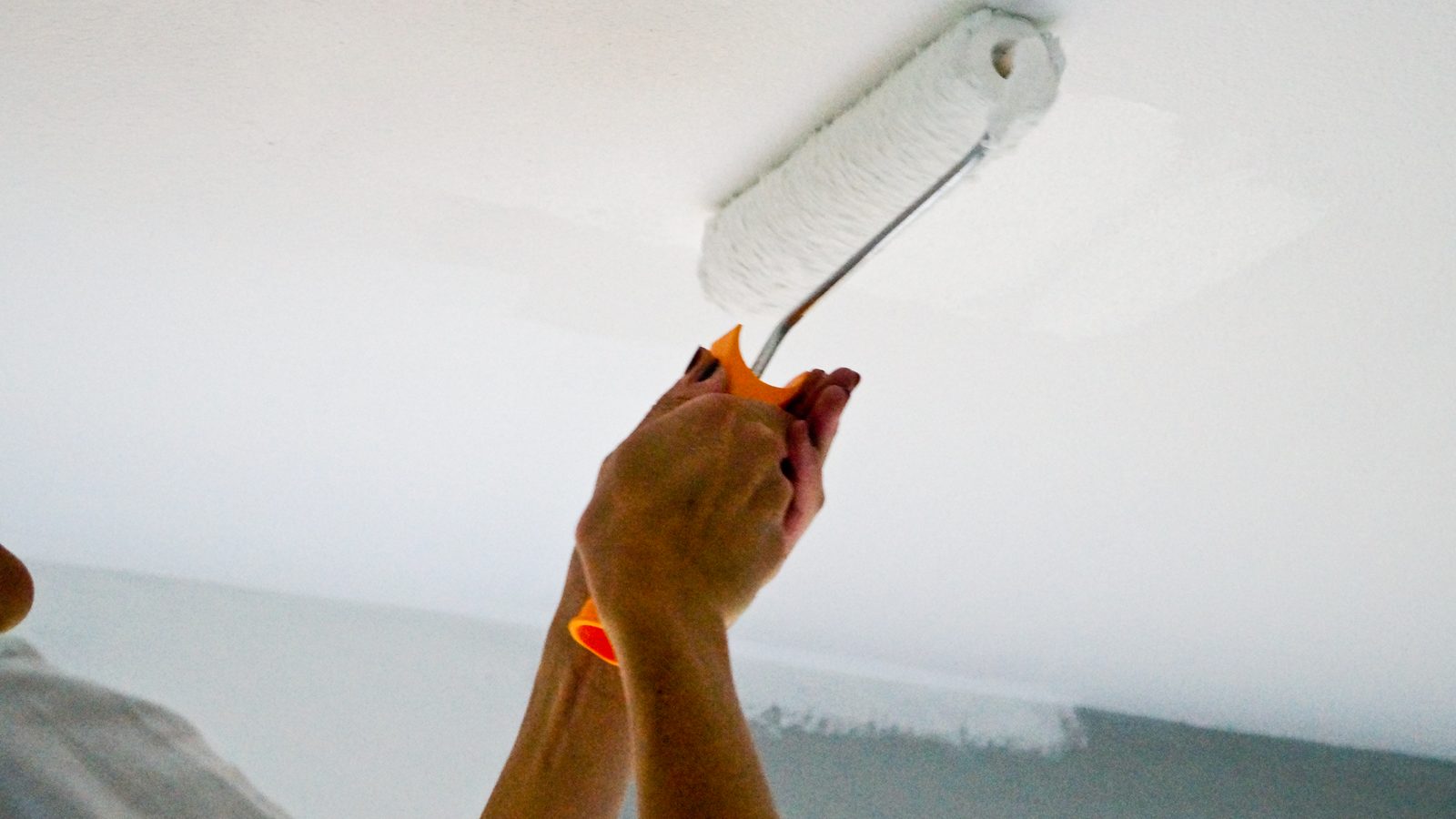
How to seal and repaint a water stain on ceiling drywall
Once the board is dry and firm, this is a straightforward job and the only real trap is the primer.
Ordinary latex or PVA primer will not hold a water stain. The stain is water soluble, the primer is water based, and the discoloration migrates straight through into your finish coat. This is the single most common failure I see, and it usually costs someone two extra coats of ceiling paint before they accept it.
| Primer type | Example | How it behaves |
|---|---|---|
| Shellac based | Zinsser B-I-N | Seals anything. Dries in under an hour. Strong smell, alcohol cleanup, and it dries slightly off white so cover the full ceiling if the room has strong light |
| Oil based alkyd | Kilz Original | Blocks water stains reliably. Slower to dry, mineral spirits cleanup, low odor versions exist |
| Water based stain blocker | Kilz Restoration and equivalents | The modern option. Easy cleanup and low odor, and it holds water stains where a general purpose latex primer does not |
| Standard latex or PVA primer | — | Will not hold. The stain returns within days |
-
Scrape back anything loose
Flaking paint, lifted paper, blistered texture. Feather the edge with a sanding sponge so the repair does not telegraph a ridge under the paint. Wear a mask, and stop immediately if the ceiling is textured and the house predates 1980.
-
Wash the area if there is any bloom
A mild detergent solution on a cloth, then let it dry fully. Skip the bleach. On porous gypsum it does very little beyond turning the color lighter and adding moisture you just spent three days removing.
-
Fill and skim if the surface changed
Water often leaves the paper slightly raised. A thin coat of compound feathered 10 to 12 in wide, sanded flat, gets you back to a surface that will not show under a lamp.
-
Prime with a stain blocker, twice on a dark stain
Brush or roll it past the stain edge by at least 6 in. Two thin coats hold better than one heavy one. Let the first go off completely before the second.
-
Paint the ceiling corner to corner
Not just the patch. Ceiling paint from a two year old can will not match itself, and a spot repaint under a window or a downlight shows as a bright patch. Full coats, wet edge kept moving.
-
Match the texture last, if there is one
Aerosol orange peel or knockdown on a test board first, always. Getting the pattern wrong on the ceiling means skimming the whole thing flat, which is the expensive repair you were trying to avoid.
Will insurance pay for it
The word that decides it is sudden. A standard US homeowners policy covers water damage that is sudden and accidental: a supply line that burst, a washing machine hose that let go, a storm that took shingles off. What it excludes is continuous or repeated seepage over a period of time, which is the language most policies use for a slow leak.
That is bad news for exactly the case in this article, because a water stain on ceiling drywall is by definition evidence that water has been arriving for a while. Adjusters know it. A single obvious event with a clear date is a much stronger claim than a ring that grew slowly.
Two practical things. Photograph everything before you touch anything, including the pencil outline with its date, because that record helps you far more than it hurts you. And report quickly. Most policies expect prompt notice and reasonable steps to limit the damage, and delay is a common reason a claim gets reduced. Read your own policy rather than a stranger’s summary of one, mine included.
Who to call, and in what order
People call the drywall contractor first because the drywall is what they can see. That is backwards, and it costs a wasted visit.
- Ceiling sagging, bulging, or water actively running: water restoration company, today. They dry it and they document it for the insurer.
- Stain tied to rain, top floor: roofer. Ask for a flashing and penetration inspection specifically, not a roof replacement quote.
- Stain under a bathroom, kitchen, or laundry: plumber. Tell them which fixture you tested and what happened, it shortens the visit.
- Stain that appeared in summer with equipment above it: HVAC technician for the condensate line and the secondary pan.
- Growth larger than about 10 sq ft, or a musty smell you cannot trace: mold remediation professional before anyone opens the ceiling.
- Leak fixed, ceiling dry, mark remains: now it is a drywall and paint job, and it is the cheapest phone call of the lot.
Questions I get on site
Can I just cover up water stains on a ceiling with paint?
Only over a stain blocking primer, and only once the board is dry. Paint alone will let the stain bleed back through, usually within a week. Paint over a wet ceiling and you seal the moisture in, which is worse than doing nothing.
How long does a stained ceiling take to dry out?
48 to 72 hours with air moving and the insulation pulled back, once the leak is actually fixed. A week or more if the cavity stayed packed and the room is humid. The meter reading is what tells you, not the calendar.
What are the early signs of water damage on a ceiling?
Before color appears you get a faint sheen difference under raking light, hairline cracking along a tape seam, paint that bubbles in a small dome, or nail heads that suddenly show as dots. A musty smell in a room with no visible mark counts too. Any of those in a house with a bathroom above is worth a look in the joist bay.
Is a small brown ring dangerous?
The mark itself is not. What it says about the cavity above it might be. A dry firm ring from a leak that was fixed two years ago is cosmetic. A ring that is growing is not, and the size has nothing to do with how much water is up there.
The stain keeps coming back through my paint. What am I doing wrong?
One of two things. Either you used a water based general purpose primer instead of a stain blocker, or the leak is still live and you are painting over fresh water. Meter it before you buy another can of paint.
Do I need to replace the insulation above it?
If it got wet, yes. Fibreglass that has been soaked mats down and loses most of its R value permanently, and it holds water against the ceiling for weeks. It is cheap to replace and it is the part everyone forgets.
Figures on this page are ranges collected from US supplier listings and contractor quotes in August 2026. They are not a quote, and regional labor rates move them. Nothing here replaces an inspection by a licensed roofer, plumber, or remediation contractor when the situation calls for one. If a number is off in your market, tell me and I will correct it.