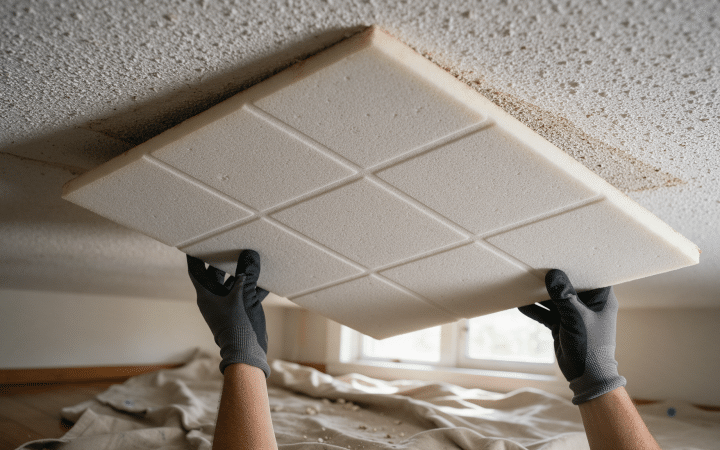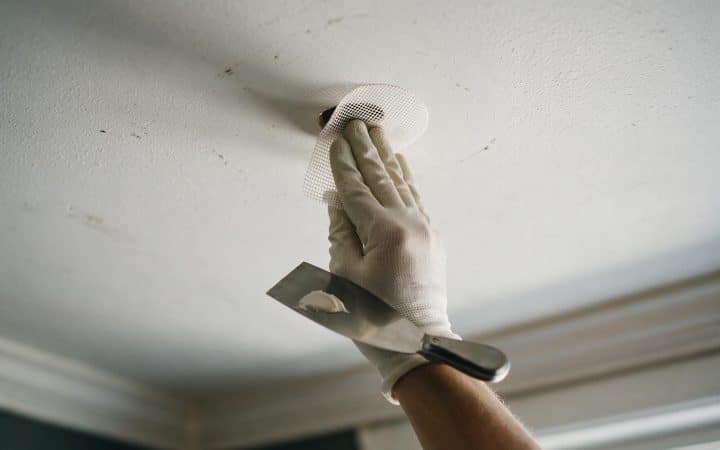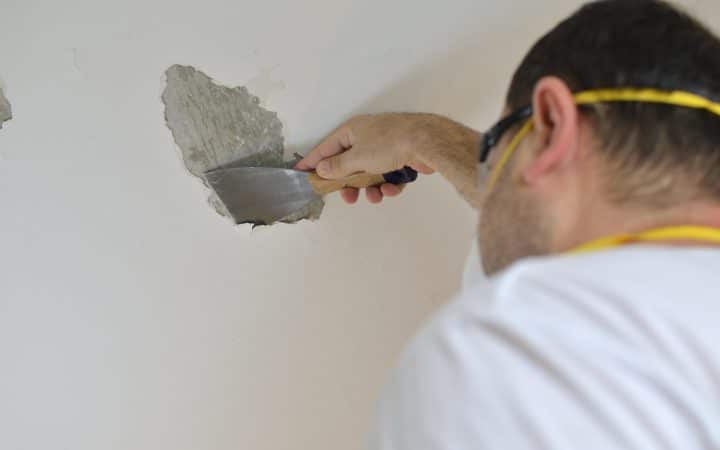
By the time a ceiling shows you a brown ring, the water has already been there long enough to leave one. I get called to read those rings all the time, and by then the only real question left is whether the drywall stays or comes out. This article sits earlier than that: it’s about the early signs of water damage on a ceiling, the days or weeks before a stain ever shows up, when almost nobody is looking yet.
Two other guides on this site pick up the story later than this one does. If you’re already looking at a stain with a defined edge, water stain on ceiling walks through reading it and whether the board stays or comes out. If water is coming through the ceiling while it’s actually raining, water leaking from ceiling when it rains traces that back to a valley, a gutter, or flashing, room by room. This one sits in front of both: for the ceiling that hasn’t stained yet and isn’t actively dripping, the one that just feels, smells, or looks slightly off, catching whatever’s happening before it earns either of those two titles.
Why the ceiling tells you before it shows you
Paint film does more work than people give it credit for. A coat of ceiling paint seals the drywall’s paper facing, which is exactly why a slow source of moisture can sit behind it for days without producing any color. Water has to accumulate, move through the paper, and pick up whatever’s in the cavity, wood tannins, dust, a trace of rust, before it reads as a stain. That lag is the whole reason this article exists.
What doesn’t lag is everything else happening while the water sits there. Paint film swells slightly before it discolors. A joist bay holding extra moisture changes how the ceiling feels under a fingertip before it changes how it looks, and damp air moving out of a cavity carries a smell before any water reaches the surface. None of that is dramatic on its own, which is why it gets missed. Stacked together, it’s worth five minutes with a flashlight.
The smell shows up before the stain does
A faint musty note in one room and nowhere else is usually the earliest tell there is. It doesn’t take a flood to produce it. Damp paper facing, wet insulation, or a joist that’s stayed moist for a few days will give off a smell long before enough water has moved through to leave a visible mark, and it’s often strongest right after the HVAC kicks on and pushes air across the ceiling.
The building side of it is simple: materials that stay wet behave differently than materials that dry out fast, and the smell is a signal about the material, not a diagnosis by itself. That’s a structural read, not a health call, and it’s not mine to make. If that side matters more to you right now, how to detect mold inside walls covers the non-destructive way to check a cavity, and how to get rid of mold on walls covers where a homeowner cleanup ends. The rest of that subject lives under moisture and mold.
From the contractor’s side, a smell with no visible source is worth ten minutes of tracing. Walk the room, note whether it’s stronger near a fixture, a vent, or one corner, and check what sits directly above: a bathroom, a roof valley, an HVAC line. A smell that fades once you open a window and stays gone is probably just a stuffy room. One that returns every time the house is closed up is doing something more specific.
A soft give where the ceiling used to be firm
Press two fingers flat against a dry ceiling and it doesn’t move. That’s the baseline, and it’s worth knowing what your own ceiling feels like on an ordinary day, because this test only works as a comparison.
Gypsum board starts absorbing water long before it looks different. The paper facing softens first, then the core underneath it, and somewhere in that process a spot that used to feel solid starts to give slightly under light pressure, almost springy instead of rigid. It’s subtle enough that people talk themselves out of it the first time they notice it, which is usually the wrong call.
Check a ceiling you aren’t worried about first
Press two fingers into a ceiling in another room, one you have no reason to suspect, before you judge the one that’s bothering you. Drywall has a small amount of natural give everywhere. Knowing what normal feels like in your own house is most of this test.
A pin-type moisture meter takes the guessing out of it and costs $25 to $40. I use the same read here that I use on a stain that’s already visible: under about 12 percent on gypsum, the board is dry, and above 16, something is still feeding it. Home inspectors lean on the same kind of tool for the same reason. InterNACHI, the nonprofit that trains and certifies most home inspectors in the US, teaches pin and pinless meters as standard practice, because touch alone catches problems too late and cutting into a ceiling catches them too destructively. A reading today and a second reading next week tells you more than either one alone.

Paint that changes texture before it changes color
Color is the last thing to change, not the first. Before a ceiling shows any yellow or brown, the paint film over a wet spot usually goes through a texture change that’s easy to miss under a ceiling light and obvious under the right light held the right way.
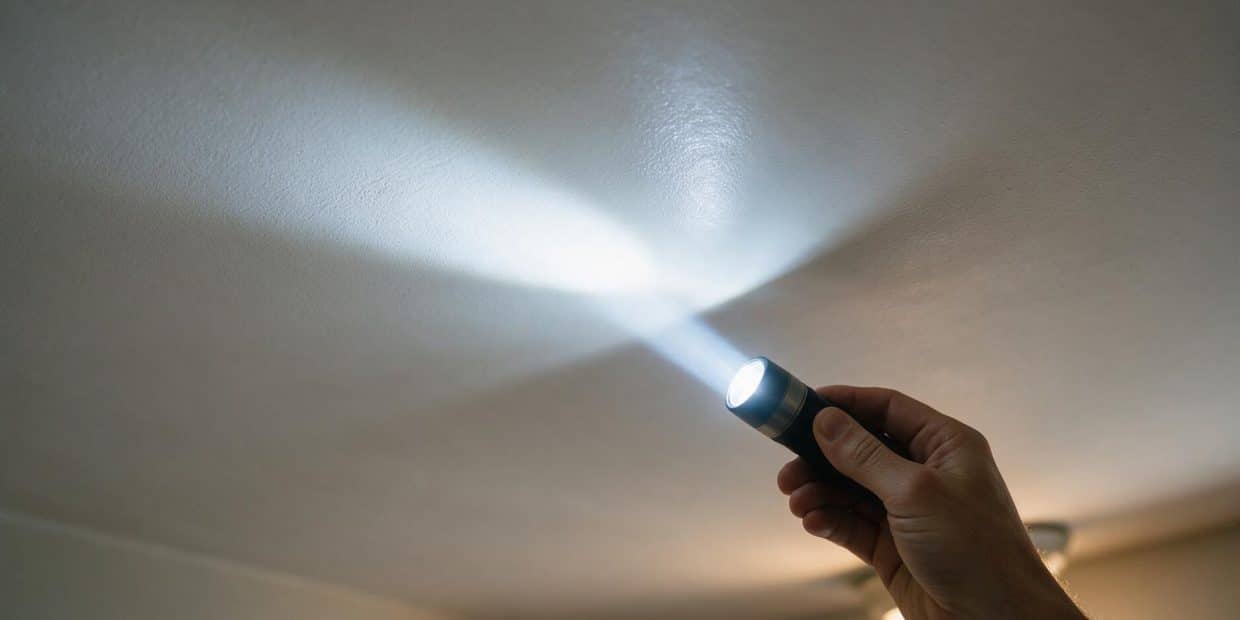
Raking a flashlight beam sideways across the ceiling, instead of straight up at it, is the trick. Held flat and low, almost parallel to the surface, the beam turns tiny differences in sheen and texture into shadow. A spot where water is sitting just behind the paint film often shows as a faint dome or a slightly different sheen against the flat paint around it, something you’d walk under every day and never notice with the room light on. ServPro, one of the restoration companies that runs these calls every day, lists bubbling or blistered paint among the most common signs homeowners report before they ever describe a stain, the same raking-light check painters use to catch roller flaws before repainting.
Two more texture tells worth checking by hand as well as by eye: fine, hairline cracking that’s new along a taped seam, which can mean the board or the framing behind it is moving as it takes on moisture, and small blisters or bubbles in the paint film with no color in them yet, which almost always mean water is sitting directly behind that patch of paint. How to fix cracks in walls covers how to tell a crack that’s just the house settling from one that means something is actively moving behind it, which applies here too.
The halo that shows up, then seems to disappear
This is the one that sends people in circles. A faint ring or halo shows up after a humid stretch or a light rain, then two days later it’s gone, or close enough that you doubt you saw it. Then it comes back after the next rain. That pattern isn’t nothing, and it isn’t the stain finally arriving either.
What’s usually happening: a small, intermittent amount of water reaches the back of the paint film, darkening it while wet, and lightening as it evaporates between events, the same way a driveway looks darker right after rain and lightens as it dries. The paper facing underneath can still be picking up a little water and a little of whatever’s in the cavity each time, even while the visible mark keeps fading. A halo that tracks with weather, more visible after rain, less visible during a dry stretch, is worth logging the way I log a stain that’s already there: pencil the outline, date it, see what the next storm does to it.
There’s a second, unrelated cause that looks similar and isn’t water at all. Building scientists call it thermal tracking, or ghosting: a faint dark pattern that follows the framing underneath, straight lines over the joists, sometimes a halo around a recessed light, caused by dust and soot settling on the slightly colder spots where insulation is thinner. Ghosting doesn’t care about rain. It builds up slowly over months regardless of weather, follows perfectly straight framing lines instead of an irregular wet-edge shape, and no amount of drying time changes it, because there’s no water to dry. A halo that’s dead straight and looks the same in a dry January as a wet April is dust, not water, and the fix is attic air-sealing, not a leak search.
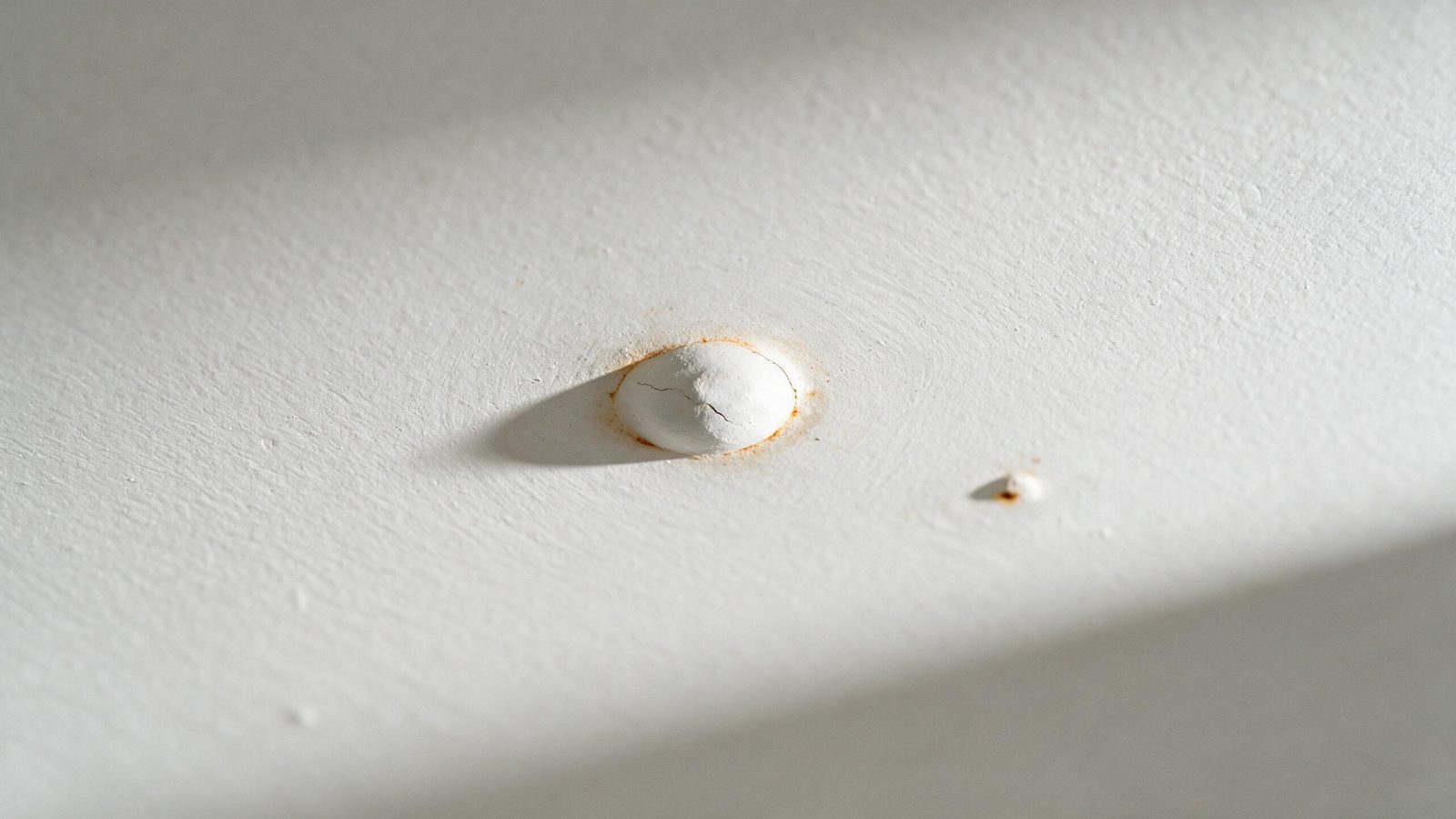
Nail pops and rust freckles that weren’t there last year
Fasteners talk too, just quietly. A nail or screw head that suddenly telegraphs through the paint as a small bump, or a faint rust-colored ring around one, is worth noting even without a stain nearby.
Most nail pops are just framing doing what wood framing does, swelling and shrinking with the season and working a fastener loose over time. Moisture changes that timeline, though. A joist bay carrying extra humidity, from a slow source or a poorly vented attic, swells the wood enough to push fasteners out faster than normal, and the rust ring around a popped fastener is often corrosion from moisture sitting against the metal rather than age alone, a pattern home-improvement outlets like Today’s Homeowner have documented for years. One popped nail on an otherwise normal ceiling is background noise; most houses have a few. Several new ones together in the same section, especially alongside a smell or a soft spot, is the framing telling you what the paint already is.
Reading the early signs
None of these alone is a reason to open the ceiling. Two or more stacking up in the same section moves this from watch it to go find out why.
| Early sign | What’s usually behind it | What to do next |
|---|---|---|
| Musty smell, no visible mark | Damp material in the cavity, source unconfirmed | Trace to what’s directly above or behind that spot |
| Slight give under two fingers | Paper facing or gypsum core starting to absorb water | Meter it, recheck the same spot in a few days |
| Faint dome or sheen change under raking light | Water sitting just behind the paint film | Treat as active until the source is confirmed stopped |
| New hairline crack along a taped seam | Board or framing moving as it takes on moisture | Compare against a photo from a few weeks back |
| Halo that darkens after rain, fades between storms | Small, intermittent source still feeding it | Pencil the edge, date it, track it through one storm cycle |
| Straight dark line on the framing, ignores weather | Thermal tracking (dust), not water | Air-seal the attic side, skip the leak search |
| New nail pops or rust rings on fasteners | Framing swelling, or corrosion from nearby moisture | Check whether they’re clustered, look at the section above |
Textured ceiling in a house built before 1980? Don’t press or scrape to check anything
The touch test here means light pressure with two fingers, never scraping, sanding, or digging at the texture. Sprayed and troweled textures applied before the US restrictions of 1977 and 1978 can still contain asbestos, with old stock used into the mid-1980s. A lab sample runs about $30 to $60 and decides what you’re allowed to do to that ceiling. Full picture: popcorn ceiling asbestos.
Don’t do the cosmetic fix yet
The instinct, once you’ve spotted one of these, is to knock it out fast: a dab of spackle on the crack, a fresh coat over the dull patch, done. That’s the same mistake as painting over a stain that’s still being fed, just earlier, and I’d rather you skip it.
Sealing or repainting before you know why it changed does two things, both bad. It hides the tell you’d use to know whether the source is still active, so next time you notice anything, you’re starting from zero instead of a dated pencil line. And if there’s any moisture still in the board, a fresh coat of standard paint traps it against the surface instead of letting it evaporate, a step backward. The EPA’s own guidance for building maintenance is direct about this: dry a wet area within 24 to 48 hours rather than letting it sit, and that clock doesn’t start until you stop covering the evidence with paint. Water stain on ceiling gets into why an ordinary latex primer won’t hold a stain that’s already fed through, for the same reason. The same logic is why I wouldn’t scrub at a faint mark to see if it rubs off, either. It doesn’t, and it usually burnishes a worse mark into the paint than the one you started with.
None of this means wait indefinitely. It means confirm before you cover. A dry, firm spot that hasn’t changed in two weeks is fine to patch and paint on its own schedule. A spot that’s still damp, still spreading, or still giving off a smell needs the source found first, or whatever repair you do now, you’ll be doing again.
What to do in the next 24 to 48 hours
-
Find what’s directly above or behind it
Stand in the room above, or check the attic, and note what sits over the spot: a bathroom, an HVAC line, a roof valley, an exterior wall. That narrows the list before you touch anything.
-
Mark it and date it
Even without a stain, a small pencil dot at the edge of a soft spot or a faint halo, dated, turns a feeling into something you can compare in a few days.
-
Meter it if you have one
A pin-type moisture meter runs $25 to $40. It turns “does this feel off” into a number. Recheck the same spot after the next rain or a hard run of the AC.
-
Get air moving, don’t seal anything
A box fan or an open window helps a damp cavity dry between checks. Skip the caulk, the spackle, and the paint until you know why it changed.
-
Watch it through one full weather cycle
One good rain, or a few days of heavy AC use in summer, tells you more than a week of dry, mild weather will. If nothing has moved by then, you’re likely looking at a closed issue, or none at all.
Monitor it, or call someone now
Most of what’s here is a monitoring problem, not an emergency. A faint smell that shows up once, one nail pop, a halo that fades within a day: worth a note and a recheck, not a phone call tonight.
- More than one early sign in the same section of ceiling: trace it this week, don’t wait for a third.
- A soft spot that’s spreading or getting softer over a few days: that’s active, not old.
- A smell that’s getting stronger instead of fading: the source hasn’t stopped.
- A bathroom, laundry room, or AC unit directly above the spot: the odds of an active source are higher there than anywhere else in the house.
- Nothing changing, no smell, one quiet nail pop, nothing else: that’s watch-and-recheck, not a phone call.
Call the trade that matches what’s above the spot: a roofer for anything under the roof deck or a chimney, a plumber for anything under a bathroom or kitchen, an HVAC technician for anything near equipment or ductwork. None of that needs a full crew today, but it’s worth starting rather than waiting for the next stage to make the decision for you.
If you’re past this article’s window already, the next two guides pick up where this one leaves off. Once there’s an actual ring with a defined edge, water stain on ceiling walks through reading it and whether the board stays or comes out. If the ceiling is already dripping, or the stain only shows up while rain is falling, water leaking from ceiling when it rains traces that back to a valley, a vent boot, or flashing, room by room. Neither is a step backward from catching it here, just the next chapter if the early signs turn out to be more than a false alarm.
Catching this early is close to free
A flashlight you already own, a $25 to $40 moisture meter, and the patience to wait a week before painting anything: that’s the entire cost of monitoring. Water damage ceiling repair cost and drywall repair cost show what the gap actually costs once a board comes out and a ceiling section needs matching and repainting, and the rest of our pricing guides live under costs. Paying attention early is the only lever here that costs nothing.
Questions I get on site
Is a faint smell with no visible stain something to actually worry about?
Something to trace, not panic over. A smell that fades once you air the room out and doesn’t return is usually nothing. One that comes back in the same spot every time the room’s closed up is worth ten minutes with a flashlight and a look at what’s directly above it.
How long can a ceiling show early signs before an actual stain shows up?
There’s no fixed timeline. It depends on how much water is involved and how well the paint film is sealing the surface. I’ve seen a slow source take months to finally show color, and a heavier one stain within a week of the first faint halo, which is why tracking the change matters more than the calendar.
Does a moisture meter actually work through ceiling paint?
A pin-type one does. The two pins push through the paint film into the gypsum underneath. Pinless meters work better on an open wall than overhead through a painted or textured ceiling, so for this job, reach for a pin meter first.
What if there’s no attic access above the spot?
You lose the easiest confirmation, not the whole method. The smell, the touch test, and the raking-light check still work from below. If those keep pointing at the same spot and you can’t get above it, that’s a good reason to call a professional rather than guess, since opening a finished ceiling blind is a bigger job than anything else here.
Is a textured or popcorn ceiling harder to read for these signs?
The smell and touch tests work the same. Raking light is harder to use since texture throws its own shadows, so lean on touch and smell there, and on identifying what texture you actually have before you assume every shadow means something. If the house or texture predates 1980, read popcorn ceiling asbestos before you press, scrape, or sand anything; popcorn ceiling removal cost covers what testing does to the price.
Should I repaint the whole ceiling once I’ve confirmed it’s nothing?
Not on this article’s account. If everything stayed dry and firm through a full weather cycle, there’s nothing to repaint, and that’s the good outcome. Save it for when there’s an actual mark to seal. Painting walls covers the wet-edge technique that keeps a touch-up from flashing under a light, and skim coat walls covers leveling the surface first if a patch needs it.
If it does turn out to be an active leak, what does the ceiling-side repair involve?
Once the source is confirmed stopped and the board is dry, it comes down to whether the drywall stayed firm or needs cutting out. A firm board usually just needs a stain-blocking primer and a repaint. A soft or spongy one gets cut back to the nearest joists, covered step by step in how to patch a large hole in drywall.
None of this requires guessing. A flashlight held low and raking, two fingers, a $25 to $40 moisture meter, and a pencil line checked after the next storm will tell you, within a couple of weeks, whether you caught a slow leak early or chased a shadow. Either outcome is a good trade: one costs twenty minutes, the other saves you the price of a ceiling. Figures on this page are US ranges as of August 2026, not a quote for your situation, and a licensed roofer, plumber, or HVAC technician should confirm the source before any repair starts. If something here doesn’t match what you’re seeing, tell me about it and I’ll take a look. More on how I work is on the about page, and the rest of this section lives under ceilings.