Wallpaper removal cost gets quoted as one number tied to square footage, and square footage is the least useful part of that number. What actually decides what you pay is how many layers are on the wall, whether any of them got painted over, and what’s underneath once the paper comes off — drywall or plaster, sound or already patched once before. Two rooms the exact same size can land $600 apart on the final invoice, and area has almost nothing to do with why.
I’ve priced wallpaper jobs since 1997, more often than not as the contractor called in after a DIY weekend went sideways. The 2026 ranges below are what I’m actually writing on quotes right now, DIY and pro, broken down by what really moves the number. If you haven’t pulled any paper yet and want the removal method itself, our guide to how to remove wallpaper without wrecking the wall walks through the score-soak-scrape process step by step. This article picks up where that one leaves off: what the job costs, and the second job that shows up right behind it, the one almost nobody prices in advance.
What actually sets your wallpaper removal cost
Three things move the price of stripping a room, and total square footage is not the biggest of them.
How many layers, and whether any are sealed under paint. One layer of ordinary pasted paper, never painted, comes off in long strips once it’s had time to soak. Add a second layer, paper hung directly over older paper (standard practice through the 1970s and 80s), and you’re not stripping one bond, you’re stripping two, because each layer holds the soaking solution differently and the scraper has to work through both separately. Paint over any layer and the water has nothing to soak into at all; a sealed surface can turn a two-hour wall into a four-hour wall before anyone’s even scraped anything.
What’s underneath: drywall or plaster. Plaster tolerates an aggressive approach. Steam it too long or over-soak it and the worst realistic outcome is a softened skim coat that needed refinishing anyway. Drywall doesn’t get the same leeway. Wallpaper paste bonds into the paper face, the thin sheet of paper glued to the gypsum core that gives drywall its smooth, paintable surface, and that bond is sometimes stronger than the bond holding the paper face to the gypsum underneath it. Pull the paper off an unlucky wall and the paper face comes with it. That single fact is most of the reason this article exists, and I’ll come back to it in the next section.
Whether this wall has been opened before. A wall that’s been wallpapered twice, or patched once and papered over the patch, is a wall where you genuinely don’t know what you’re dealing with until the paper is off. Old spot repairs under wallpaper are common, and they’re rarely finished to the same level as the surrounding wall, because nobody expected anyone to look closely at a patch that was about to be covered. Removal exposes every shortcut that was ever taken on that wall and never painted over directly.
Put those three together and the size of the room barely registers next to them. A small bathroom with two layers of painted vinyl on drywall that’s never been touched can cost more to strip than a large bedroom with one clean layer on solid plaster.
The line most quotes skip
Every wallpaper removal cost calculator I’ve checked prices one job: the scrape, in dollars per square foot. Almost none of them price the job that follows it, and on old pasted paper over drywall, that second job isn’t optional. It’s the reason a quote that looked reasonable on paper turns into an invoice nobody budgeted for.
Here’s the mechanism. Removal tears at the paper face wherever the paste bond is stronger than the paper itself, which on old drywall is more often than any calculator admits. What’s left behind is fuzzy, torn gypsum that soaks up paint and joint compound unevenly. Skip the repair step and the wall doesn’t fail today. It fails two coats of paint later, as bubbling compound or a patchwork of flat and glossy spots that has nothing to do with how carefully anyone rolled the paint on. Our removal guide calls this the step everyone skips, and it’s not an exaggeration; it’s the single most common reason a clean-looking removal still looks obviously wrong a week later.
Sealing and skimming is often 30 to 40 percent of a finished job
On a $700 finished bedroom, scraping alone is usually $175 to $200. Sealing the paper face and skim-coating where it tore is closer to $250 to $300 of the same bill. A quote that only mentions the scrape is quoting less than two-thirds of the job most homeowners actually want.
A clear primer-sealer made for damaged drywall runs $20 to $25 a quart and covers roughly 200 square feet, cheap insurance against a callback. If the tear is bad enough to need more than a sealer (visible gouges, fuzzy patches you can feel with a flat hand), that’s not a wallpaper cost anymore, it’s a drywall finishing cost. Professionally, a skim coat runs $1.90 to $3.40 per square foot, the same range in our drywall repair cost breakdown, and it stacks directly on top of whatever the removal itself billed. That stacking is the entire reason two “wallpaper removal” quotes for the same room can be $500 apart: one of them is quietly including the repair, and one of them is going to send you a second invoice.
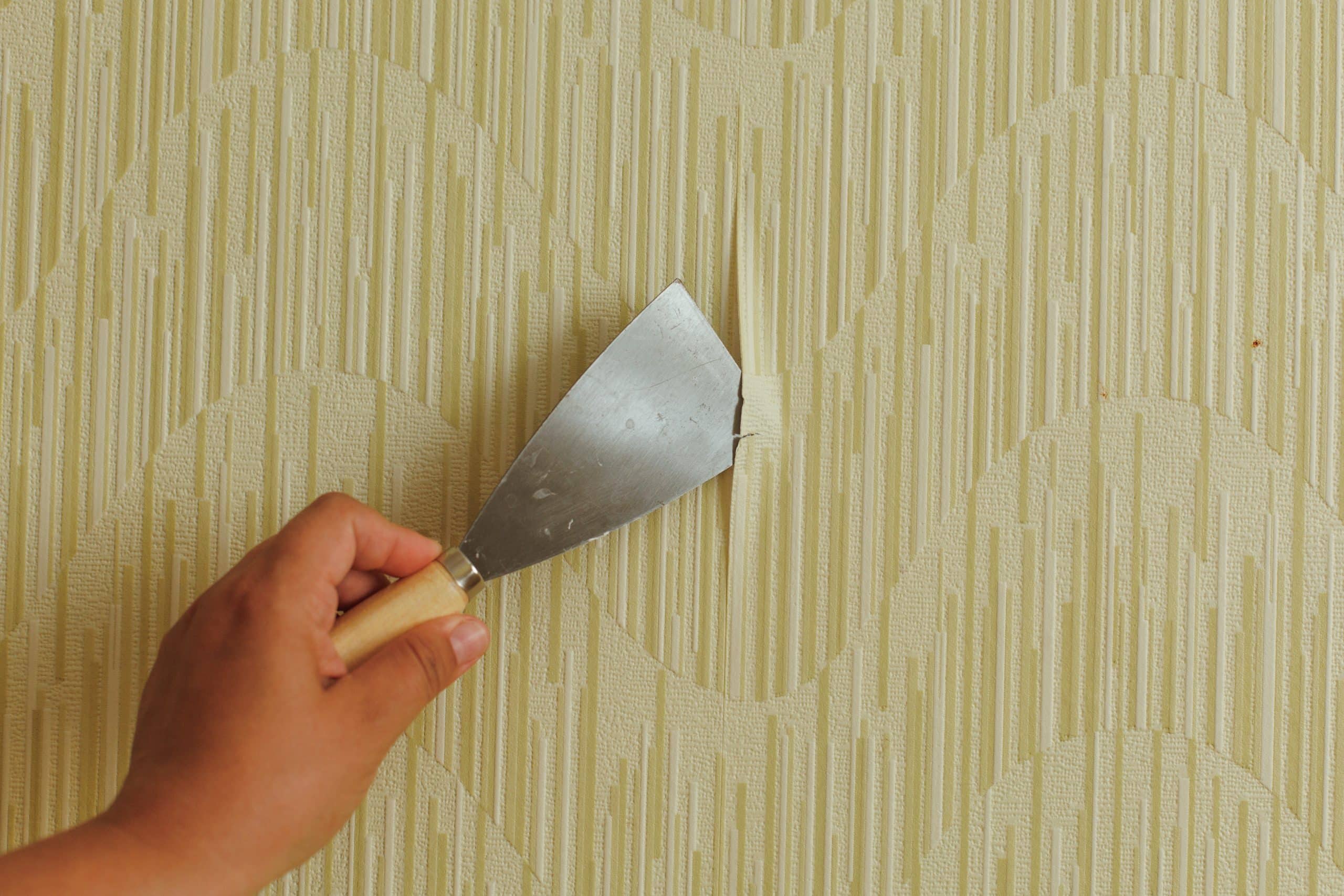
Wallpaper removal cost by method
Four ways to get paper off a wall, and four different cost profiles. Most single rooms don’t need all four; pick the row that matches what’s actually on your wall.
| Method | What it involves | Typical cost |
|---|---|---|
| DIY score and soak | Scoring tool, pump sprayer, putty knife, solution | $15–$40, one room |
| DIY steamer rental | Rented wallpaper steamer plus solution | $25–$35/day + $15–$25 |
| DIY chemical stripper | Concentrate, sprayer, ventilation | $20–$35 |
| Professional, scrape only | Labor and haul-away, wall left bare and unfinished | $0.60–$1.50 per sq ft |
| Professional, scrape, seal, skim, paint | Finished wall, ready to live with | $1.50–$3.00 per sq ft |
Notice the gap between the last two rows. That gap is the sealing and skim work, not a markup. When a quote comes in near the bottom of the range, ask which of those two rows it’s actually describing before you compare it to anything else.
Wallpaper removal cost by room size
Figures below are wall area, not floor area, and assume one layer of ordinary pasted paper that hasn’t been painted over. The next section prices what happens when that assumption doesn’t hold.
| Space | Approx. wall area | DIY materials | Pro, scrape only | Pro, fully finished |
|---|---|---|---|---|
| Powder room or small bath | 100–150 sq ft | $20–$45 | minimum charge, $150–$300 | $250–$450 |
| Bedroom, roughly 12×12 | 350–400 sq ft | $40–$90 | $320–$500 | $450–$1,000 |
| Living or dining room | 450–600 sq ft | $60–$130 | $400–$700 | $600–$1,400 |
| Whole house, multiple rooms | 1,800–2,200 sq ft | $150–$350 | $1,600–$2,800 | $2,800–$6,000 |
Look at the powder room row. A small bathroom has less wall area than almost any other room in the house, and it still costs close to what a bedroom scrape does. Below roughly 150 square feet, the minimum charge and the setup time swallow the square footage math completely, because masking a room, running a sprayer, and coming back to sand takes about the same effort whether the wall is 100 square feet or 250. That’s the same trip-charge effect that shows up in our drywall repair cost guide, and it’s why bundling a small bathroom with a bigger job nearby is almost always cheaper than booking it alone.
Layers and paint change the math more than square footage does
Everything in the tables above assumes the easiest version of the job. Real walls, especially in older homes, are rarely that cooperative. Here’s roughly what to add to a baseline scrape price once you know what’s actually on the wall.
| Condition | Change to baseline scrape cost |
|---|---|
| Single layer, strippable vinyl, unpainted | -10% to -20% (the easy case) |
| Single layer, pasted paper, unpainted | Baseline |
| Single layer, painted over | +40% to +100% |
| Two layers, paper hung over paper | +50% to +90% |
| Three or more layers, or vinyl over paper | +100% to +150%, or priced as a drywall overlay instead |
Painted wallpaper is the one people underestimate most. Paint seals the paper the same way it seals a popcorn ceiling texture — the soaking solution has nowhere to go, so a crew ends up scoring more aggressively, sometimes with a tool like a Paper Tiger that punches through the paint layer, and saturating the wall twice instead of once. That’s real labor, not a padding fee, and it’s the single biggest jump in this whole table.
Three or more layers is where I stop quoting removal at all and start pricing a drywall overlay or a full tear-out instead, the same fork covered in our popcorn ceiling removal cost guide for a different surface entirely. Past a certain point, fighting a wall’s whole history one layer at a time costs more than starting over.
Drywall or plaster: the fork that decides your risk
Two houses, same wallpaper, same square footage, and the substrate underneath can put one of them at double the other’s cost. This is the fork I check before I’ll quote a flat number over the phone.
Plaster walls, common in homes built before the 1950s, are dense and largely indifferent to water and heat within reason. A steamer can run longer on plaster without much consequence, which is exactly why our removal guide recommends steam more readily there than on drywall. The removal itself might take slightly longer per square foot because plaster paste bonds can be stubborn, but the repair bill afterward is usually small: a few gouges, not a torn skin across the whole wall.
Drywall, standard in anything built from the 1960s onward, is the substrate where the redo tax from the section above actually shows up on an invoice. The paper face is thin, it’s glued on, and old pasted wallpaper bonds into it aggressively enough that a wet method and a shallow scraping angle stop being optional technique advice and start being the difference between a $700 job and a $1,100 job. This is also where I quote a range instead of a flat number, because I genuinely can’t tell how much paper face is coming off with the paper until the first section is scraped.
If a scraper catches an edge and takes an actual chunk of gypsum with it rather than just the paper face, that’s no longer a sealing job. Treat it like any other drywall hole — our large hole patching guide covers the cut-and-float method by size, and the cost sits inside the ranges in our drywall repair cost breakdown, not the wallpaper numbers on this page. Getting a skim coat to disappear invisibly under paint afterward is its own skill worth reading up on — our skim coat guide breaks down the GA-214 finish levels and what each one actually takes.
What pushes a quote to the top of the range
Six things move a wallpaper removal cost quote, roughly in order of how often I see them add up on a real job.
- Paint sealing the paper. Covered above, and the single biggest line item on this list. Add 40% to 100% to the scrape.
- Drywall instead of plaster. Higher odds of paper-face tearing, which means higher odds of the sealing-and-skim job stacking on top.
- Multiple layers. Each additional layer is close to a second removal, not a small add-on.
- Ceiling height and access. Stairwells, two-story foyers, and anything needing staging instead of a stepladder add 15% to 30%.
- An occupied, furnished room. Masking furniture and protecting flooring from a wet process takes real time that an empty room doesn’t need.
- Pre-1978 paint on top of the paper. Lead-safe work practices apply once a contractor disturbs more than 6 square feet of painted surface in a home that old, and certified lead-safe contractors price accordingly. Our removal guide covers what that actually requires if you’re doing it yourself instead.
Where the money actually goes on a professional job
Here’s a real breakdown from a 350-square-foot bedroom, single layer, painted over, scraped and finished to a paintable wall for $700.
| Line | Share | Amount |
|---|---|---|
| Labor, scraping | 25% | $175 |
| Labor, sealing the paper face | 10% | $70 |
| Labor, skim coat where paper tore | 30% | $210 |
| Labor, prime and paint | 20% | $140 |
| Materials | 8% | $56 |
| Trip and setup | 7% | $49 |
Materials are under a tenth of the total. You are not buying primer and joint compound for $700. You are buying someone who knows the paper face tore before you do, and who prices the repair into the job instead of discovering it after the invoice was already agreed to.
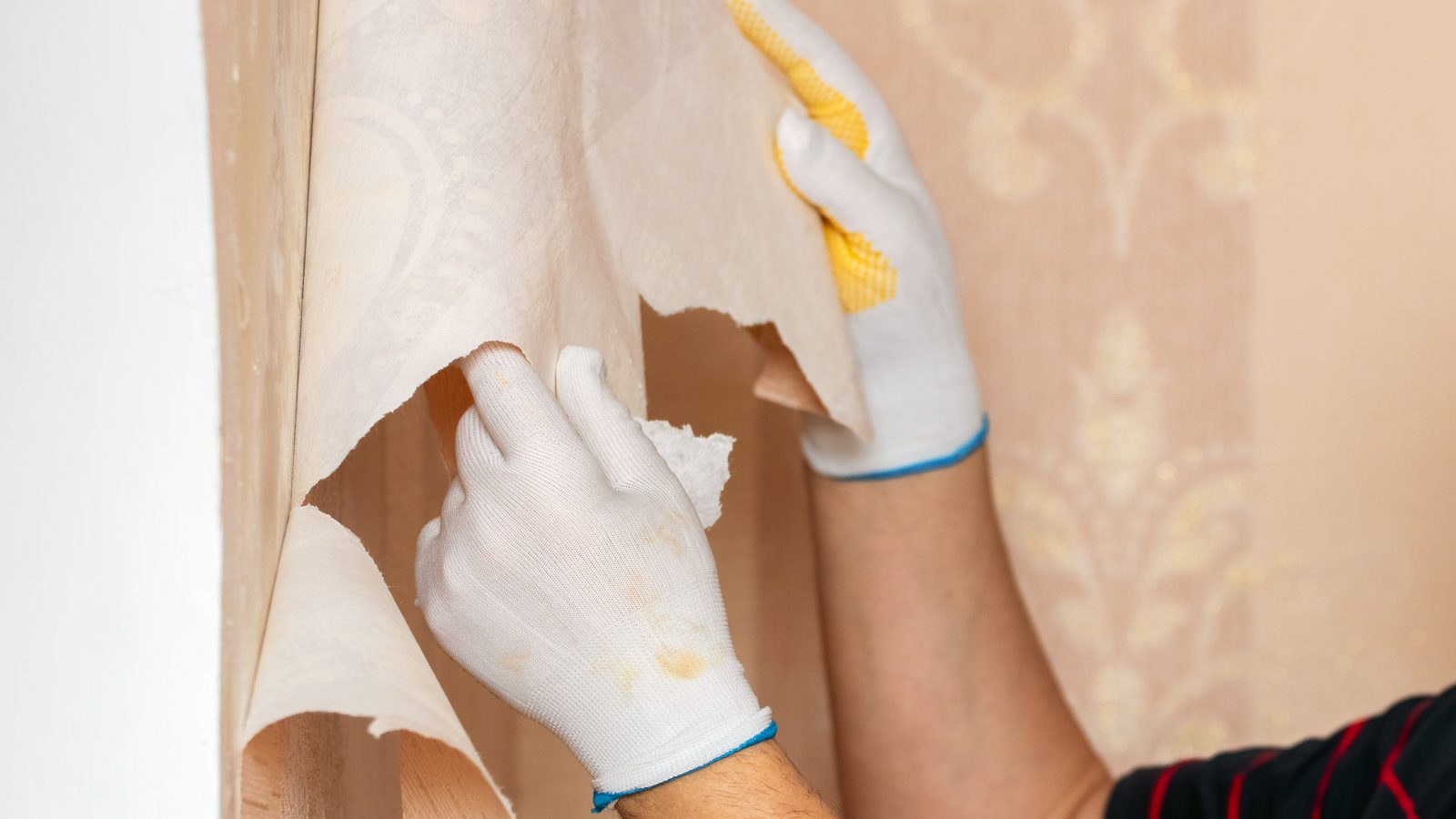
Doing it yourself: what you save and what you take on
Materials for a DIY removal run $15 to $40 for a single room using the score-and-soak method, which our full removal guide walks through start to finish, including three homemade stripping solutions that work as well as most bottled products. That’s the real saving, and on a straightforward, unpainted, single-layer wall, it’s a legitimate weekend project.
What DIY actually risks isn’t the scraping. Scraping is slow and a little tedious, but it’s forgiving to learn. What it risks is skipping the sealing step, because nothing about a freshly stripped wall looks like it needs it. Dry gypsum looks fine to the eye even when the paper face is already torn and fuzzy under a flat hand. I’ve walked into more than one “we stripped it ourselves, no big deal” room where the first coat of paint was already bubbling before the painter finished the second wall. That’s exactly how a $30 DIY removal turns into a $200 skim-coat repair two weeks later.
The split job is the best value on this page
Scrape it yourself, then pay a finisher to seal, skim where needed, and paint. You keep the labor that needs patience but no real skill, and you buy the labor that does. Have the finisher look at the bare wall before you quote the painting, so they’re pricing the job they’ll actually get.
My rule after 29 years of pricing this work: if the wall is painted, has more than one layer, or is drywall you’re not confident about, get a number before you open a spray bottle. If it’s one clean layer on a wall you already know is sound, it’s a Saturday and under $40.
How to read a wallpaper removal cost quote
A quote you can actually compare against another one answers these questions without you having to ask twice.
-
Ask how many layers they counted, not just the square footage
A price based on wall area alone hasn’t accounted for the layers table above. Two rooms the same size with different histories should not get the same number.
-
Confirm whether sealing is included
If “Gardz,” “primer-sealer,” or “shellac primer” doesn’t appear anywhere on the quote, ask directly. Its absence is the number-one reason a low quote stays low.
-
Ask what happens if the paper face tears
A contractor who’s done this before has an answer ready: a per-square-foot skim rate, not a shrug. A shrug means you’re funding their learning curve.
-
Get the finish level in writing
“Paint-ready” and “primed” are not the same promise. Ask which one you’re buying, in those words.
-
Check who supplies the steamer or stripper
Equipment and solution should be in the contractor’s cost, not itemized separately unless you agreed to that upfront.
-
Compare the minimum charge, not just the total
Two quotes at $350 and $550 can invert the moment you add a second room, because one contractor is mostly charging to show up and the other is charging by the work.
Questions I get on site
What is the average wallpaper removal cost in 2026?
Most single-room jobs I quote land between $450 and $1,200 for a fully finished, paint-ready wall. A small, clean, single-layer room can come in under $350. A painted, multi-layer wall on drywall that needs real repair afterward can clear $1,500. The size of the room predicts this far less than the layers and the substrate do.
How much does wallpaper removal cost per square foot?
$0.60 to $1.50 for a scrape-only job, $1.50 to $3.00 for a scrape finished through paint. The rate only means much above roughly 150 to 200 square feet; below that, the minimum charge and setup time dominate and a per-square-foot number stops being useful.
Is it cheaper to remove wallpaper or just replace the drywall?
Removal is almost always cheaper than a full tear-out and replace, usually by half or more. The exception is a wall with three or more layers, extensive water damage underneath, or paper face torn across most of the surface, where the labor to salvage the existing board can approach what a fresh sheet of drywall, hung and finished, would cost instead.
Does wallpaper removal cost more if it’s painted over?
Yes, and by more than most people expect: 40% to 100% more than the same paper unpainted, because the soaking solution has nothing to soak into until the seal is broken. See the layers table above for the full breakdown by condition.
How much does it cost to remove wallpaper and repaint?
Add $150 to $400 per room for painting on top of the removal and repair numbers on this page, depending on room size and whether it’s one coat over primer or two full coats. Our drywall repair cost guide has more detail on paint pricing as its own line item, since it applies the same way to a repaired wall as it does to any other patched drywall.
Are online wallpaper removal cost calculators accurate?
They’re fine for a rough order of magnitude and not much else, because almost none of them ask the two questions that actually move the number: how many layers, and is any of it painted. A calculator that returns one number for a whole room without asking either is guessing at the same rate you are.
Should I hire a wallpaper removal service or a general painting contractor?
Either can do it well. What matters more than the label on the truck is whether they talk about sealing and repair unprompted. A painter who scrapes, seals, and skims as one job usually costs about the same as a dedicated wallpaper removal service and saves you a second contractor and a second trip charge.
Does removing wallpaper add value to a home?
It shortens time on market more reliably than it raises the appraisal. Dated wallpaper reads as a project to most buyers, and a plain, freshly painted wall reads as move-in ready. I wouldn’t budget it as an investment with a guaranteed return, but I’d do it before listing a house that still has it.
Why did my quote come in far lower than the others I got?
Almost always because it’s missing the sealing and repair line, not because that contractor is simply cheaper. Go back through the six questions in the “how to read a quote” section above before you accept the low number; the gap usually explains itself in about two minutes on the phone.
What I would do
If you’re not committed to removal yet, it’s worth ruling out the alternative first — our guide on whether you can paint over wallpaper walks through the three wall checks that decide whether that shortcut actually holds, and it can save you this entire cost if your wall passes. If you’re already committed, test a corner first. If it dry-peels clean or wets and scrapes easily in one layer, do it yourself over a weekend and budget $150 to $400 for a professional to seal, spot-skim, and paint afterward — you’ll almost certainly need at least the sealer, even on a clean-looking wall. If it’s painted, layered, or you’re not sure what’s under it, get two quotes and ask both contractors the same six questions above before comparing a single number between them.
The number that ends up on your invoice has far more to do with what’s under the paper than with the paper itself. Nobody selling the removal has much reason to lead with that, which is roughly why this page exists. The rest of our costs section covers the neighboring jobs, and if you want new paper back up once the old wall’s sorted, how to hang wallpaper without the seams showing later picks up from here.
Got a quote you’re trying to make sense of? Send it through the contact page with the room size and whether it’s painted. I read them all.
Figures on this page are ranges pulled from US supplier listings and contractor quotes current as of August 2026. They are not a quote for your job, and your zip code, wall condition, and a contractor’s schedule all move them. If a number is off in your market, tell me and I’ll correct it.