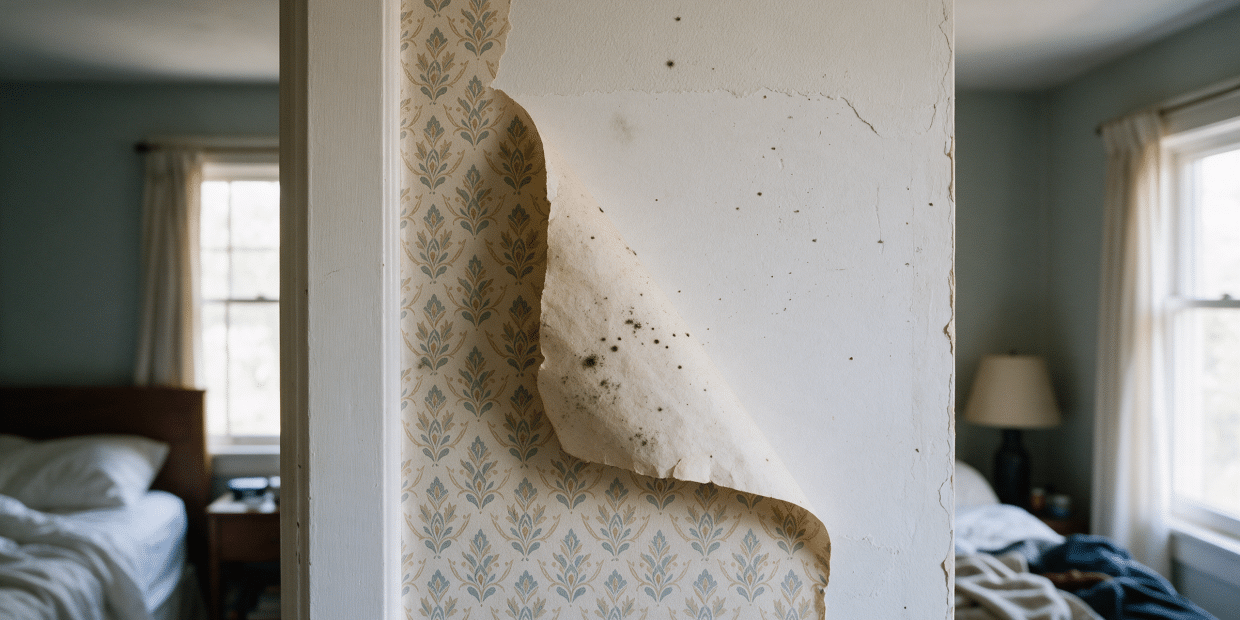
Mold behind wallpaper almost always means water is reaching the wall, and the paper is holding it there. The stain you see on the front is the late signal. The useful question is not how to clean it, but how far it goes and what keeps feeding it.
Most cases sort into one of three outcomes: a spot you can wash off a firm wall, a section of board that has to be cut out, or a patch big enough that a remediation company should take over. This guide shows how to tell which one you have before you tear off a single strip, then walks through the cleanup, the drying, and how to hang paper again without repeating the problem.
It builds on how to get rid of mold on walls, which covers cleaning painted drywall in detail. What changes when wallpaper is in the way is the diagnosis: the growth is hidden, the paper is part of the problem, and the first step is different.
Signs of mold behind wallpaper you can check without stripping it
Wallpaper hides the evidence, so you read the symptoms instead. None of them proves mold on its own. Two or more in the same spot is a strong reason to look behind the paper.
| What you see or feel | What it usually points to | Next move |
|---|---|---|
| Musty smell that is stronger at one wall, or near an outlet | Damp cavity or damp paper backing venting into the room | Check that wall first, then the outlet cover with the power off |
| Bubbles or blisters that return after you press them flat | Moisture pushing the paper off the wall from behind | Do the press test below before regluing anything |
| Seams lifting in one area while the rest of the room is fine | Local dampness, often near a window, pipe or exterior corner | Look for the water source in that spot |
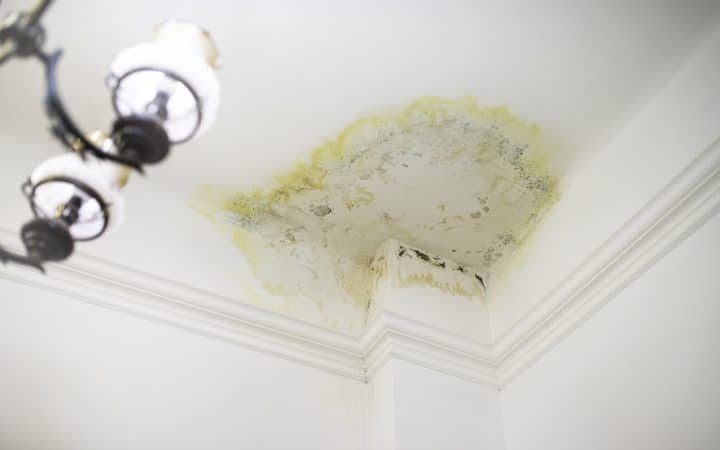
| Yellow, brown or gray stains showing through the paper | Water carrying stain from the wall or paper backing to the surface | Peel a hidden corner and look |
| Dark speckles on the seams or along the top edge | Growth on the paper or paste, worked through to the face | Treat as confirmed and follow the steps below |
| Wall feels cool, clammy or soft under the paper | Wet or saturated board | Stop and check the board before any cleaning |
Peel a corner where nobody will see it
Behind a dresser, inside a closet, or high in a corner: lift a two-inch flap of paper and look at both the wall and the back of the paper. A clean, dry, off-white back means the problem is probably elsewhere. Dark dots or a musty smell on the back tells you what you are dealing with, and the flap goes right back down with a dab of seam adhesive if you were wrong.
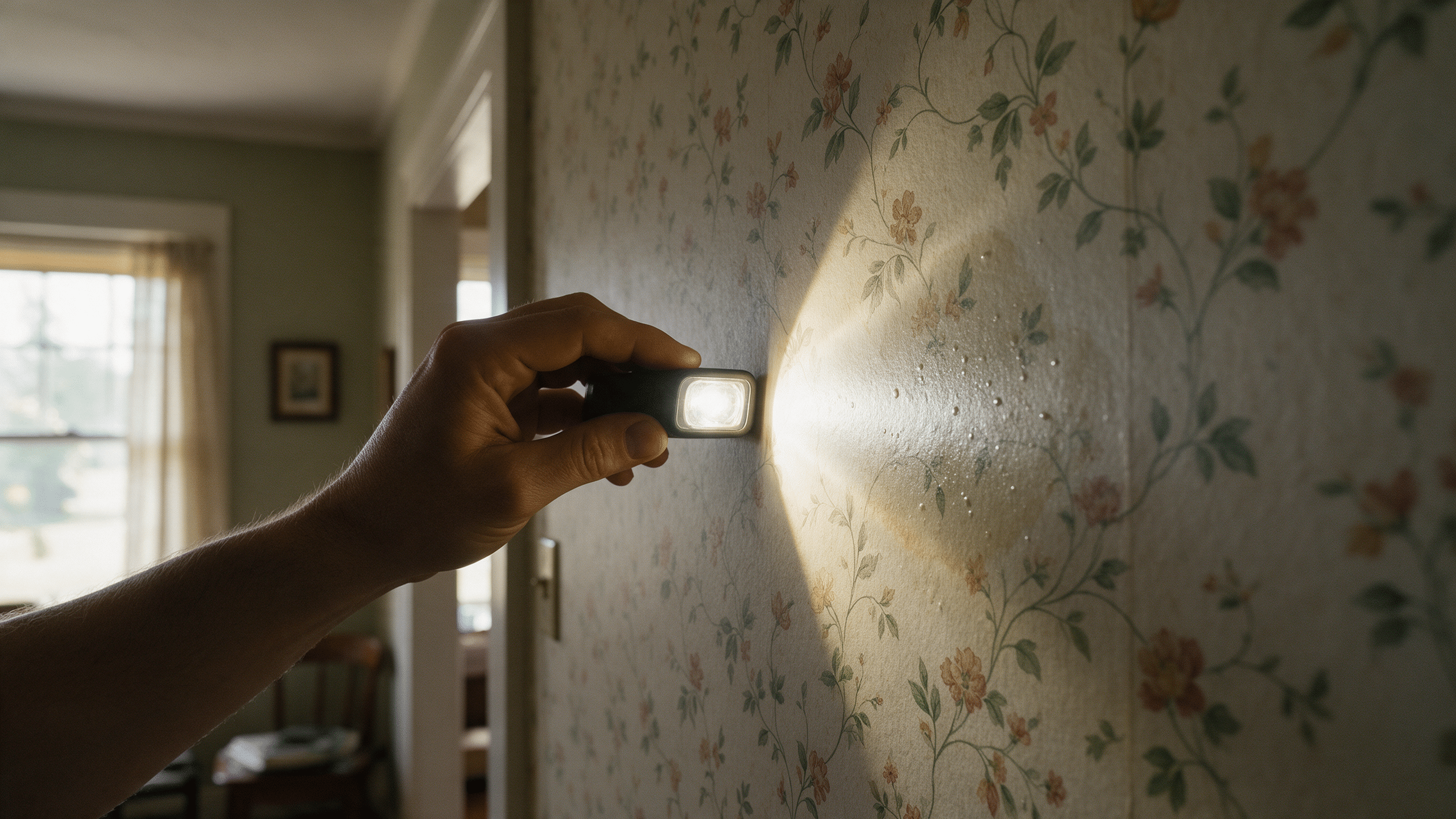
A flashlight held almost flat to the wall shows the same thing across the whole room in a few minutes. Raised bubbles, a faint tide line and a slightly different sheen all show up in raking light long before they are obvious in normal daylight. Sweep every exterior wall and any wall that shares a bathroom or kitchen.
Why mold grows behind wallpaper in the first place
Mold needs moisture and a food source, and the wall already supplies the food. Paper facing on drywall is cellulose. Wallpaper paste is starch or cellulose based, and the paper itself can be food too. That leaves moisture as the only variable, which is why the fix always begins with water rather than with the mold.
Wallpaper adds a second problem: it slows drying. Any water that gets behind it, from a slow leak, a cold wall sweating, or steam from the next room, has a much harder time getting back out. A painted wall can release moisture into the room. A wall under a solid vinyl covering often cannot.
| Wallpaper type | How it handles moisture | Risk on a damp or cold wall |
|---|---|---|
| Plain or uncoated paper | Lets some moisture through, absorbs and shows stains | Stains and lifting show early, which is useful |
| Vinyl-coated or solid vinyl | Sheds water on the face and holds it behind | Higher: moisture trapped between vinyl and wall |
| Peel-and-stick | Film backing with adhesive, little breathability | Higher: humidity softens the adhesive and traps damp air |
| Wallpaper over old wallpaper | Every extra layer slows drying more | Higher: paste in the lower layer keeps feeding growth |
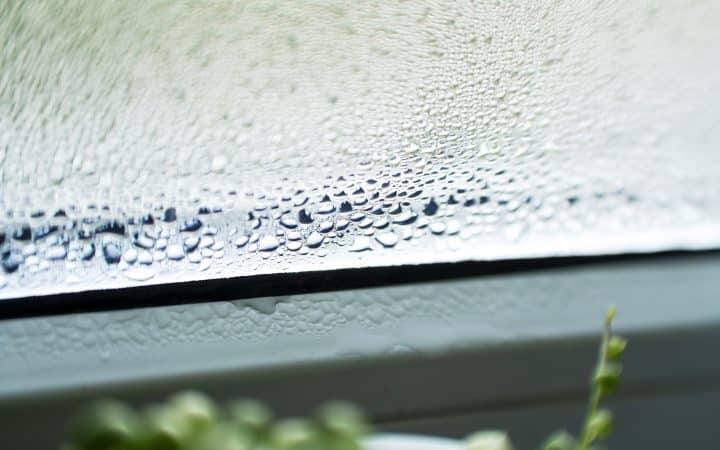
The same handful of sources show up again and again. A bathroom with a weak fan sends steam onto the nearest wall. An exterior wall with thin insulation stays cold enough for condensation, the same mechanism behind condensation on windows but hidden behind paper. A slow supply line or roof leak feeds one stripe of wall for months. Or a new layer of vinyl went over an already damp wall and sealed the problem in.
Is it mold behind the wallpaper, or something else?
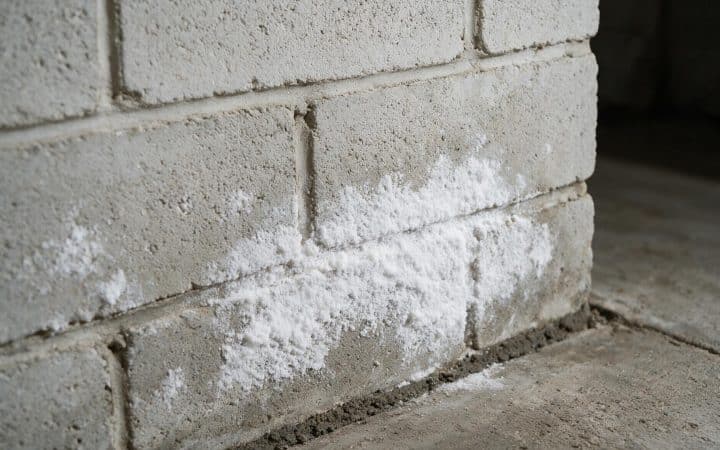
Not every dark mark is growth. Old paste stains, soot film, and salt deposits from masonry walls can all look alarming. Efflorescence on basement or garage walls is the classic false alarm, and the efflorescence guide shows how to separate white mineral crust from the real thing.
Three quick checks on an exposed patch: dab it with a damp cloth, smell it up close, and press a fingertip on it. Mineral stains and dust wipe away or crumble. Mold stays put, smears, and usually carries a wet-cardboard smell. If the patch is on the paper backing only, the wall behind may still be sound. If it is on the wall as well, the board is next on the list.
When to stop and call a pro
The US EPA says homeowners can typically handle mold cleanup themselves when the affected area is under about 10 square feet, roughly a 3 ft by 3 ft patch. Count the hidden part too: if stripping the paper shows growth over more than that, or the growth follows a flood, sewage backup or a leak inside the wall, stop and get a remediation quote. See the EPA mold cleanup guidance. In a house built before 1978, older paint layers under the paper may contain lead, so keep the wall wet while scraping and never dry sand it. This page says nothing about health effects. If anyone in the home feels unwell, that is a question for a doctor, not a contractor.
What to do about mold behind wallpaper, step by step
This sequence is for a patch under 10 square feet on a firm wall, on wallpaper you are willing to lose in that section. Skip the first step and the rest is temporary.
-
Find and stop the water
Trace the source before you cut anything: a plumbing line, a roof or window leak, a fan that vents into the attic, or a cold wall with no insulation. Then wait through one full cycle of whatever wets it. If the paper stays dry, you have found the source.
-
Photograph it, then set up the room
Take a wide shot and a close-up with a tape measure in frame. Turn off the heating and cooling so air is not pulled through the room, open a window, close the door, and put on an N95 respirator, gloves and sealed eye protection.
-
Strip past the edge of the damage
Wet the paper with warm water and remove it in strips, working outward until the wall behind looks clean and dry on all sides. Wet stripping keeps dust down. Bag each strip on the spot.
-
Press the wall
Push two fingers into the exposed board at the center of the patch. Firm and springy means the core is sound. Soft, crumbly or a dent that stays means the gypsum has taken on water. That section is a cut-out, not a clean-up.
-
Wash, do not scrub
On firm painted or primed board, use warm water with a few drops of dish soap and a soft brush, then a rinse cloth. Rinse in a separate bucket, change rags often, and bag everything before it leaves the room. Never dry brush or sand growth.
-
Dry it for real
Run a fan across the wall at an angle and a dehumidifier until the board and any paste residue are completely dry. Then leave it exposed for several days and watch for the shadow returning in the same footprint.
-
Clear the paste, prime, then finish
Remove paste residue, let the wall dry, and use a stain-blocking primer if any staining remains. Only then paint or hang new paper.
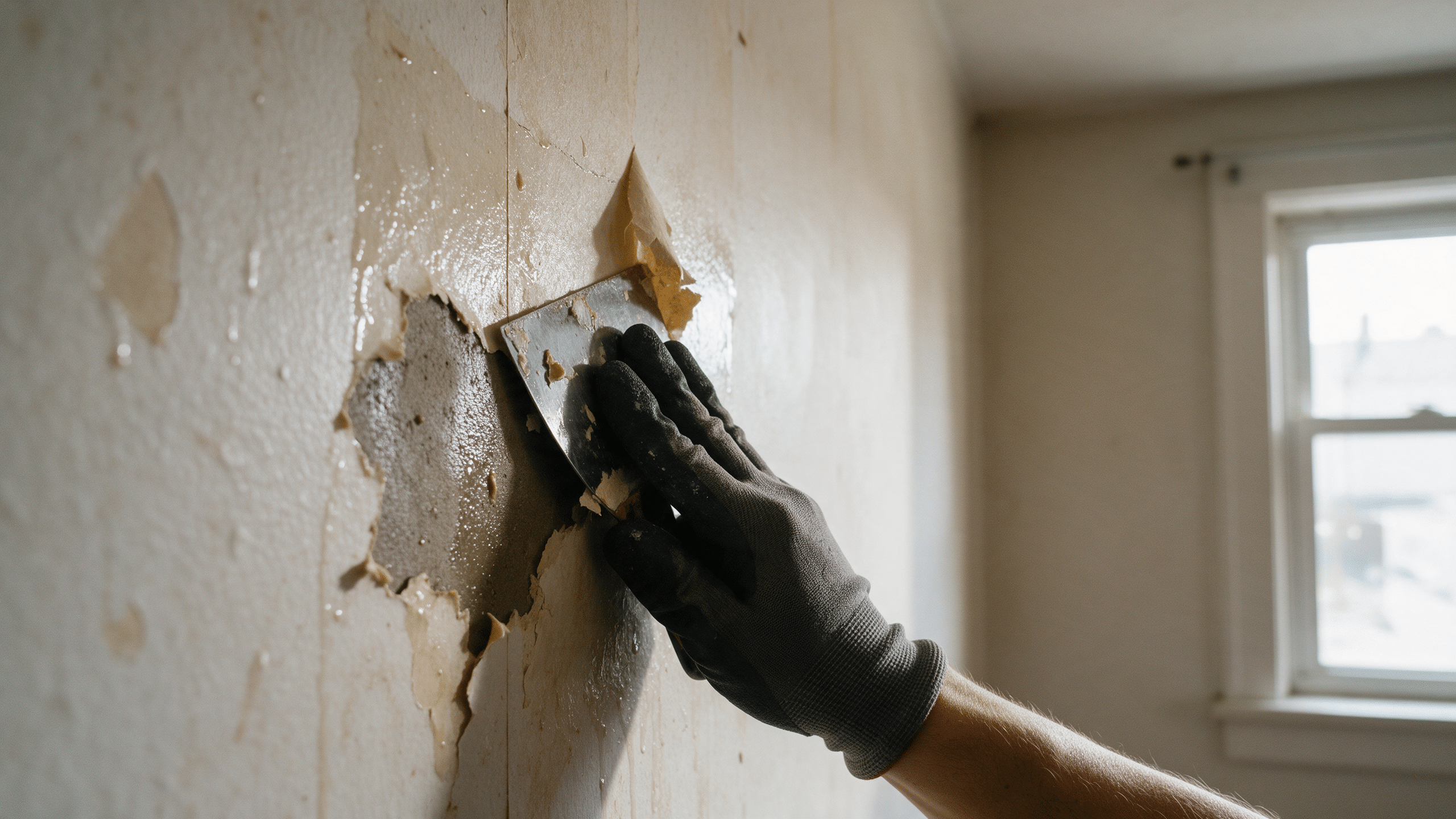
The stripping itself is the same job described in how to remove wallpaper without wrecking the wall underneath. The difference is the order: you find the water first, and you strip with the assumption that whatever is under the paper is not clean.
When the wall is too far gone to clean
Soft, spongy or crumbling board has lost its paper facing to the mold and the water, and cleaning only changes the color. The EPA notes that absorbent materials may have to be thrown away once they turn moldy, because growth works into the material and cannot be fully removed. Board falls in that group.
When a section has to come out, cut a clean rectangle back to the studs, let the cavity dry completely, and patch it with new board. Look at what is inside first. Damp insulation or growth on the framing turns this from a patch into a containment job. The guide to detecting mold inside walls covers how to look in a cavity before you commit.
If the same wall keeps returning to this point, the problem is upstream. New board on a wall that still gets wet just grows the same patch, a year later, in a fresh place.
Putting wallpaper back without inviting mold back
Once the wall is dry, sound and primed, the choice of covering matters more than the pattern. On a cold exterior wall, in a bathroom, or on any wall with a moisture history, a breathable paper or a painted finish is safer than a solid vinyl. Vinyl on a wall that has ever been wet is asking for a repeat.
If you decide to skip paper entirely, whether you can paint over wallpaper depends on the state of the wall behind it, and on a wall with a moisture history the honest answer is usually no. Lifting seams that are not mold at all are a different repair, covered in how to fix peeling wallpaper.
Two habits lower the odds of a repeat. Keep furniture a couple of inches off exterior walls so air can move, and run the bathroom fan through every shower and for a while after. Neither costs anything, and both address the actual cause.
Common questions
How long does it take for mold to grow behind wallpaper?
Once paper and board stay wet, growth can start within days. The mold on walls guide gives a window of roughly one to three days on wet material. Paper and paste that never fully dry give it even more time.
Does wallpaper attract mold?
Paper and paste are food, but water is what starts the growth. Wallpaper mostly makes an existing moisture problem worse by slowing drying, especially solid vinyl and peel-and-stick.
Can I clean mold off wallpaper instead of removing it?
Surface speckles on a plain paper covering sometimes wipe off, but growth on the back of the paper does not. If there is growth behind the paper, the section has to come off.
Should I paint over mold behind wallpaper?
No. Paint is a finish, not a treatment. It traps moisture and the same patch returns through the coat, usually with a softer edge. Find the water, clean and dry the wall, then prime.
Is mold behind wallpaper a sign of a leak?
Often, but not always. A slow leak, condensation on a cold wall and bathroom steam all produce the same pattern. The location of the growth points to the cause: low and vertical suggests plumbing or foundation, high on an exterior wall suggests condensation.
Is it a bad idea to keep wallpaper in a bathroom?
It can work with strong ventilation and a moisture-tolerant covering, but solid vinyl in a steamy room with a weak fan is a common cause of this problem. Painted walls are simpler to manage there.
Can I hire someone just to look behind the paper?
Yes. A pro can open a small inspection hole and use a moisture meter. That is worth paying for when the smell is clear but the source is not, or when the affected area is near or over the EPA’s 10 square foot line.
Where to start
Peel a hidden corner, do the press test on the wall, and look at the back of the paper. Small patch on firm board with the water found: wash, dry and reprime. Soft board or a patch that keeps growing: cut it out or bring in a pro. Whichever it is, fix the water before you touch a roll of new paper.
More on the water side of the house lives in moisture and mold, and the paper side is in wallpaper.