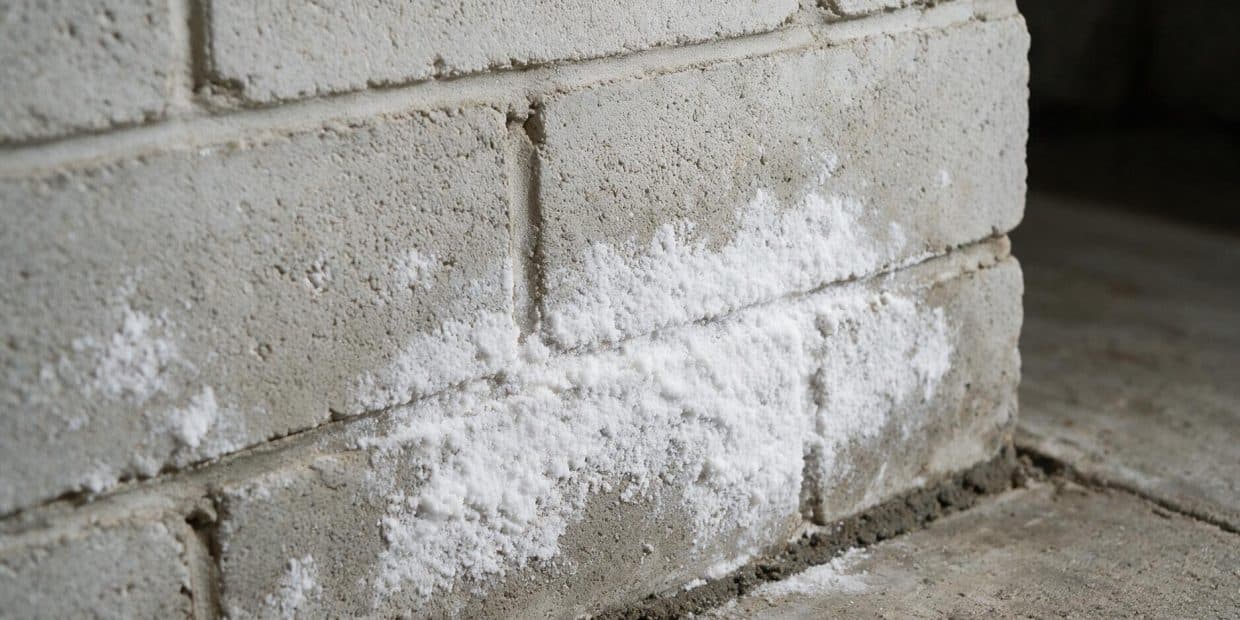
Somewhere between a quarter and a third of the “black mold” calls I get on a basement wall turn out to be salt. A homeowner sees white fuzz creeping across a block wall, reads one article about toxic mold, and calls me before eight in the morning. I get there, touch it, smell it, and it isn’t mold at all. It’s efflorescence: mineral residue left behind after water has already passed through the wall and evaporated at the surface. Harmless to touch. Not harmless to ignore.
That’s the trap with efflorescence on walls. It looks cosmetic, so people either panic over nothing or brush it off and move on, and both reactions skip the one question that actually matters: is the wall drying out for the last time, or is it telling you water is still finding a way in? The crust looks identical either way. The only thing that tells the two apart is what it does over the following weeks, and almost nobody bothers to watch for that.
Twenty-nine years of reading walls for a living taught me to treat efflorescence as a message instead of a stain. Here’s what the salt is actually made of, why some walls throw it once and go quiet forever while others produce it every spring like clockwork, what US building code has to say about the moisture behind it, and when a fifteen-dollar bottle of cleaner is the whole job versus when it’s the first sign of something that costs a lot more.
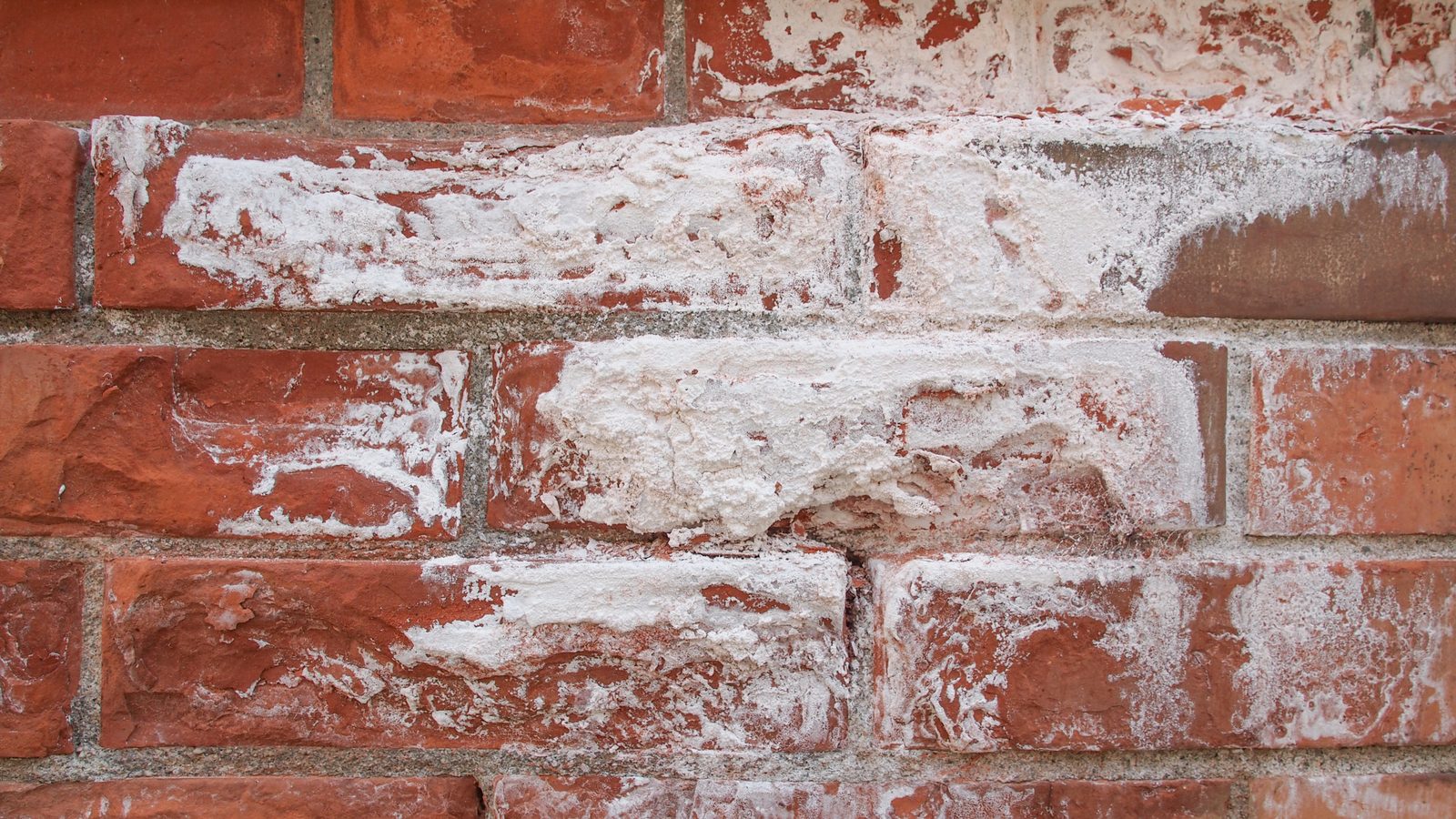
What efflorescence on walls actually is
Efflorescence is a crystalline deposit of soluble salts, usually some mix of calcium, sodium, potassium and magnesium compounds that were already sitting inside the concrete, mortar, brick, stucco or block before the wall was ever built. Portland cement carries calcium hydroxide and other soluble compounds as a normal part of curing. None of that is a defect in the material. It’s baked into what masonry and concrete are made of.
Water is what moves those salts to where you can actually see them. Rain hitting a foundation wall from outside, groundwater wicking up through a slab, a leaking gutter dumping water against a block wall, condensation sitting in a damp basement all winter — any of these will dissolve the soluble salts already inside the material and carry that solution toward whichever surface is drying the fastest. When the water reaches the surface and evaporates, the salt can’t evaporate with it. It crystallizes out and stays behind as the chalky white bloom you’re looking at.
That’s also why location tells you something before you touch anything. Efflorescence needs three things at the same time: a porous material carrying soluble salts, water to dissolve and move them, and a path for that water to reach a surface and evaporate. Take away any one of the three and it stops. Painted drywall on an interior partition almost never shows it, because gypsum board doesn’t carry anywhere near the load of soluble salts that concrete and mortar do, and it’s rarely sitting in direct contact with a water path the way a foundation wall is. Brick manufacturers have been grading this for decades under ASTM C67, the standard test method for sampling and testing brick, which includes a controlled wetting test specifically for how much soluble salt a given batch will throw. Efflorescence has been a known, measured variable in American masonry since long before anyone was searching for it online.
Reading where it shows up: masonry, block, brick, and rarely drywall
Where the crust actually forms narrows down the cause faster than anything else about it, the same way the shape of a water stain narrows down a leak.
| Where you see it | What’s usually behind it |
|---|---|
| Concrete or block basement wall, worst near the floor | Groundwater wicking up through the slab or the wall by capillary action |
| Brick or block veneer, exterior, worse after a hard rain | Water entering above through a cap, coping, or a failed weep hole, then drying outward through the face |
| New concrete or block, first year or two | Construction moisture leaving the material for the first time, usually a one-time event |
| Garage or basement wall behind stored boxes or furniture | Dead air trapping humidity against that one spot long enough for it to wick and evaporate there |
| Painted drywall (rare) | Almost never true efflorescence. Check for a masonry or block wall on the other side, or reconsider whether it’s actually soot, dust, or paint chalking |
| Mortar joints specifically, brick faces mostly clean | Salts concentrated in the mortar mix itself rather than the brick, common with certain masonry cements |
I’ve been called out to bedrooms for “mold” that turned out to be efflorescence bleeding through a skim coat over a block foundation wall that somebody finished without a vapor break behind it. That’s the one interior case where it shows up on what looks like a normal painted wall, and it’s a giveaway that the finish system was applied straight over masonry without anything to stop moisture migration first.
Primary vs secondary efflorescence on walls: which one you have
Not all efflorescence means the same thing, and this is the distinction that almost nothing written for a general audience bothers to make, even though it’s the one that actually decides whether you should worry.
Primary efflorescence is construction moisture leaving for the first and only time. New concrete carries a surprising amount of water, often more than the mix technically needs, because extra water makes it easier to place and finish on a job site. As a new foundation, block wall, or slab cures and dries out over its first six to eighteen months, whatever soluble salt is in that material rides the departing water to the surface once, sometimes twice, and then the reserve runs out. A new basement that throws a haze of white in its first spring is usually doing exactly this. Once that batch of construction water is gone, the salt goes with it.
Secondary efflorescence is different, and it’s the one worth taking seriously. It shows up on a wall that’s been standing for years, or it keeps coming back on the same wall season after season no matter how many times you brush it off. That pattern means water isn’t a one-time leftover from construction. It’s an ongoing supply arriving from somewhere outside the wall, on a repeating basis: groundwater under hydrostatic pressure, a downspout still dumping at the foundation, a grade that slopes toward the house instead of away from it, or a crack letting bulk water through on every hard rain. The salt was never the problem. It’s the receipt for a moisture path that’s still open, printed fresh every time conditions line up.
The test I actually use on site
Clean the wall completely, let it dry, and mark the date in pencil nearby. If the crust doesn’t return within a full season, or comes back thinner and fades out, that was primary efflorescence working through the last of the construction moisture. If it returns at roughly the same intensity, especially after the next heavy rain or spring thaw, you’re looking at secondary efflorescence — and cleaning it again without dealing with the water is the same mistake as painting over a stain that’s still being fed.
Is efflorescence on walls dangerous, or just cosmetic?
On its own, efflorescence isn’t structural, and it isn’t the thing to actually worry about. The salt crystallizing on the surface doesn’t weaken concrete or brick, and it isn’t something you need to avoid touching or breathing, no matter how many black-mold headlines you’ve read this month.
What can be a genuine problem is a related process called subflorescence, or cryptoflorescence: the same soluble salts crystallizing just under the surface instead of on top of it, inside the pores of the brick, block, or mortar rather than on the visible face. Crystals growing inside a confined pore exert real pressure as they form, the same basic mechanism that cracks a sidewalk over repeated freeze-thaw cycles, and over enough cycles that pressure can spall the face off brick or block from the inside out. That’s a masonry-durability question rather than a this-week emergency, but it’s also why “it’s just salt, leave it alone” is bad advice on a wall that keeps producing it year after year. A wall throwing secondary efflorescence for a decade has had a decade of repeated wetting and drying working on it from the inside, whether or not the face has visibly started to flake yet.
The bigger and more immediate issue is usually what the water is doing on its way through, and that has nothing to do with the salt itself. Water carrying dissolved minerals to a basement wall is the same water that can raise indoor humidity, feed a musty smell, soften a base plate, or set up the conditions for real mold growth on any wood framing, drywall, or stored belongings nearby, especially once that moisture migrates from a block foundation wall into a framed wall or finish sitting against or above it. That’s the connection worth taking seriously: efflorescence on the masonry is often the early, visible version of a problem that shows up later as something much more familiar. If you’re seeing both the white crust on a block wall and a musty smell or soft drywall nearby, that’s no longer a masonry-only question. How to detect mold inside walls covers the non-destructive way to check whether it’s already reached the framed side.
Efflorescence vs. mold vs. three other white-wall look-alikes
Mold is the mix-up everybody asks about first, but it isn’t the only thing that gets misread as efflorescence on a job site. I’ve scraped, tested, or wiped away all five of these at one point or another for a homeowner who was sure it was salt, or sure it was mold, and was wrong either way.
| What it is | Where it shows up | Water test | Feel |
|---|---|---|---|
| Efflorescence | Masonry, block, brick, concrete, mortar joints | Dissolves, then redeposits if the water evaporates again | Crumbles to a fine, gritty powder |
| Mold or mildew | Anywhere, including painted drywall | Stays put, doesn’t dissolve | Has depth, smears rather than crumbles |
| Dust and soot | Cold framing lines, above radiators and baseboard heaters | Wipes off dry, no water needed | Flat, wipes clean in one pass |
| Laitance | Freshly poured concrete surface, first few weeks | Rubs off as fine dust immediately, no water needed | Chalky, weak surface skin |
| Paint chalking | Painted exterior masonry or siding, sun-exposed sides | Rubs off on a dark cloth or bare hand, tinted rather than white | Powdery, colored to match the old paint |
Laitance is the one even some contractors mix up with efflorescence, and it isn’t the same thing at all. It’s a weak, cement-rich film that rises to the top of a fresh concrete pour, especially if it was overworked with a trowel or hit with rain before it cured. It shows up in the first weeks of a slab or wall’s life, rubs off as a fine dust with zero water involved, and it’s a finishing issue rather than a moisture one. Paint chalking is the other easy mix-up on an older exterior wall: it’s the paint’s own binder breaking down under UV exposure, and it always carries a hint of the paint’s original color instead of being pure white.
For a quick call at the wall, three checks settle almost every case. Spray it with a little water: efflorescence dissolves and mold doesn’t. Pinch it between two fingers: efflorescence crumbles to grit, mold smears. And check where it’s growing: efflorescence needs masonry or concrete to carry the salts, so painted drywall in a bedroom is very unlikely to be efflorescence no matter how much it looks like it from across the room.
How to clean efflorescence off a wall, step by step
Cleaning is the easy half of this job, and it’s also the half almost every article online focuses on exclusively, which is part of why so many homeowners clean the same wall every spring without ever fixing anything.
| Item | Use | Rough cost |
|---|---|---|
| Stiff nylon or brass wire brush | Dry-brush the bulk of the crust off before any liquid touches the wall | $8–$15 |
| Efflorescence remover (buffered or phosphoric-acid masonry cleaner) | Dissolves residue plain water alone can’t fully lift | $15–$30/gallon |
| Diluted muriatic acid (alternative, more aggressive) | Heavier deposits on bare, unpainted masonry only, never on finished surfaces | $10–$20/gallon |
| Rubber gloves, goggles, acid-rated respirator | Required for either acid-based cleaner | $20–$40 |
| Garden pump sprayer and stiff-bristle scrub brush | Apply cleaner evenly and agitate it into the surface | $15–$25 |
| Breathable, vapor-permeable masonry sealer | Applied only once the wall is confirmed dry and the water source is under control | $30–$70/gallon |
-
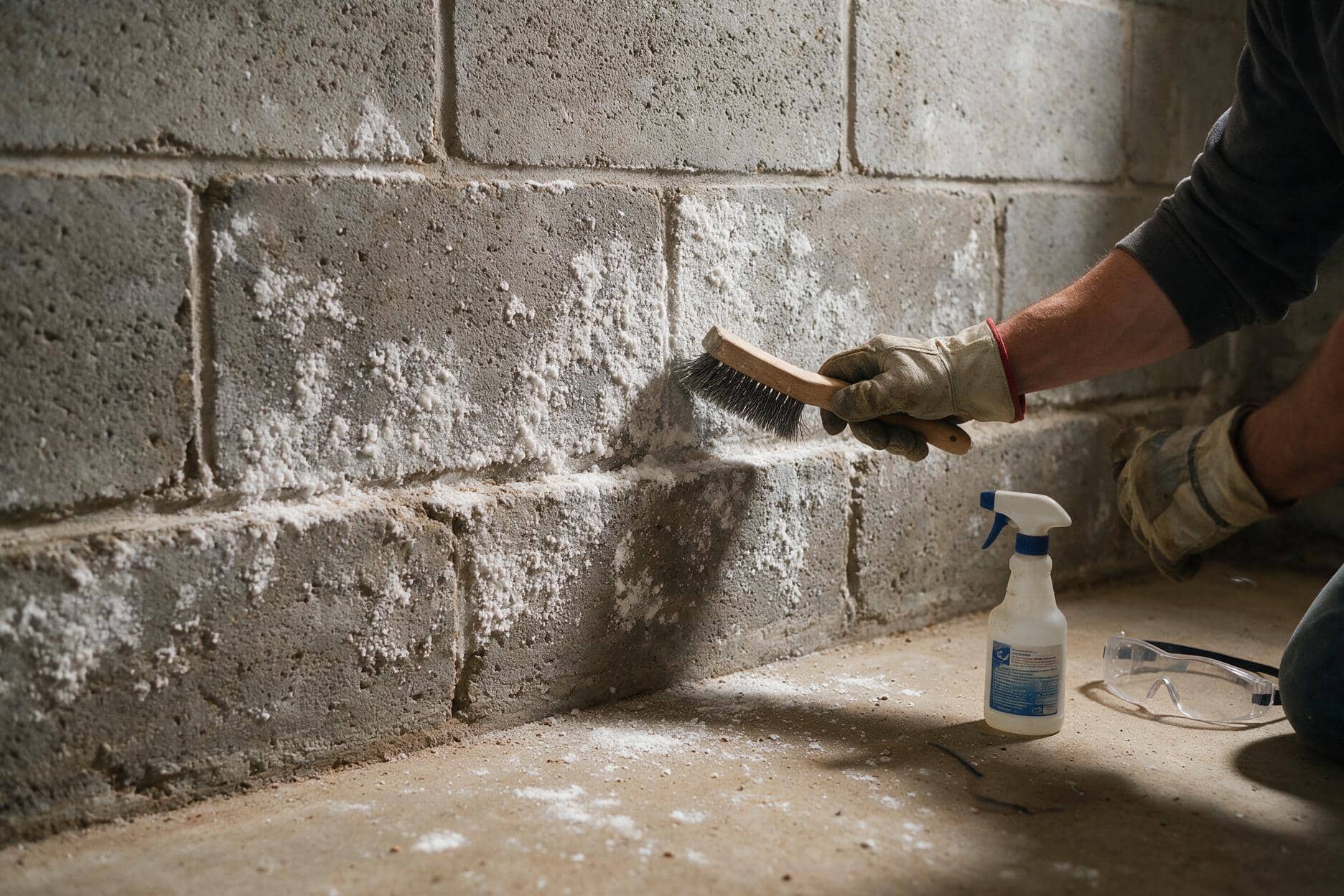
Dry-brush first. Never start with water.
Knock off as much of the loose crust as you can with a stiff brush before any liquid touches the wall. Starting wet redissolves the salt right back into the surface pores instead of removing it, which is the single most common reason a “cleaned” wall looks hazy again within a day.
-
Test a hidden section first
Apply the cleaner to a small, out-of-sight patch and check it after a few minutes, especially on painted or colored masonry. Some acid-based cleaners can lighten mortar tint or etch certain finishes.
-
Apply the efflorescence remover in small sections
Work one manageable area at a time rather than soaking the whole wall at once, following the dilution on the label. Straight muriatic acid is overkill for most residential jobs and it’s much less forgiving if you get the ratio wrong.
-
Agitate while it’s working
A stiff-bristle brush in small circles while the cleaner is still wet lifts the crust out of the surface texture instead of just staining over it.
-
Rinse completely, more than feels necessary
Any leftover acid residue keeps working on the mortar long after you’ve moved on, and any leftover dissolved salt left in solution just redeposits as the rinse water evaporates. A garden hose on a low, wide spray does this better than a bucket and rag.
-
Let it dry fully, then mark the date and wait
Don’t decide anything the same day. Give it a full season if you can, watching for whether the crust returns and how strong it comes back, before you decide whether you were looking at primary or secondary efflorescence.
-
Seal only after the water source is dealt with
A breathable, vapor-permeable sealer applied over a wall that’s still taking on water from behind just moves the crystallization to a spot the sealer doesn’t cover, or worse, traps the moisture and creates a subflorescence problem under the coating. Sealing is the last step, not a substitute for the drainage work below.
Stopping efflorescence on walls for good: drainage, dampproofing, and what the code says
Cleaning the salt off is maintenance. Stopping it from coming back means dealing with the water, and residential building code already has a framework for that question, even though almost nobody outside the trades has ever opened the book.
The International Residential Code’s foundations chapter, adopted in some form by most US states, draws a distinction that’s worth knowing even if you never crack the code book open yourself. Dampproofing and waterproofing are not the same requirement, and most residential foundation walls only need the first one. Dampproofing is the baseline for a foundation wall enclosing habitable or usable space below grade. It resists moisture moving through the wall by capillary action from damp soil sitting next to it, which is the everyday case. Waterproofing is a stricter standard, called for specifically where a high water table or other site conditions mean the wall will face real hydrostatic pressure, standing water physically pushing against it rather than just damp soil resting there. A wall that only ever needed dampproofing but is now throwing recurring, secondary efflorescence is a wall where something in that everyday moisture picture has changed, or wasn’t done correctly the first time.
The code also leans hard on managing water before it ever reaches the wall coating, and that order matters more than people expect. Grading around a foundation is supposed to fall away from the house, and downspouts are supposed to discharge well clear of the foundation rather than right against it, because keeping bulk water away from the wall in the first place does more than any sealant applied after the fact ever will. The EPA’s own moisture control guidance for building design and maintenance takes the same drainage-first position for the building envelope generally, and it’s consistent with what I actually find on site: the most common source behind a secondary efflorescence problem isn’t a failed waterproofing membrane. It’s a downspout dumping water directly against the foundation, or a flower bed that’s crept up against the house over a few years of added mulch and topsoil until it buried the bottom few inches of the wall.
Working from cheapest to most expensive, here’s the order I’d actually check before pricing anything bigger:
- Extend downspouts so they discharge at least 4 to 6 feet from the foundation, more if the ground nearby is close to flat.
- Check that the grade slopes away from the house for at least the first 6 to 10 feet. A long board and a level settle this in about five minutes.
- Clear gutters twice a year. A gutter overflowing at one seam does the same damage as having no gutter at all, right at that spot.
- Pull mulch, soil, or planting beds back so they don’t bury the bottom of the foundation wall or cover a weep screed.
If the wall is still throwing secondary efflorescence after all four of those check out clean, the water is very likely coming from below rather than from the surface, either hydrostatic pressure from a high water table or a below-grade crack, and that’s a job for interior drainage (a perimeter drain tied to a sump) or exterior excavation with a real waterproofing membrane. A better cleaner isn’t going to fix either one. The Brick Industry Association’s own technical notes on masonry moisture land in the same place: control the water at the source and the salt problem mostly takes care of itself.
What treating efflorescence costs in 2026
The spread on this job is enormous, and almost none of that spread has to do with the size of the white patch. It’s set by whether you’re cleaning a symptom or fixing a source.
| Job | DIY materials | Typical pro cost, 2026 |
|---|---|---|
| Clean and seal a small area, under 25 sq ft | $25–$80 | $200–$500 |
| Clean and seal a full basement or garage wall | $75–$200 | $600–$1,800 |
| Extend downspouts and correct grading | $30–$100 | $300–$1,200 |
| Interior perimeter drain plus sump pump | Not a typical DIY job | $2,500–$8,000 |
| Exterior excavation and membrane waterproofing, full foundation | Not a typical DIY job | $6,000–$15,000+ |
| Masonry or engineer inspection to confirm the cause | — | $300–$700 |
That first row is the entire job for most homeowners reading this. Primary efflorescence on a wall that’s drying out for the last time needs a brush, a bottle of cleaner, and maybe a sealer once it’s confirmed dry. It’s the bottom two rows that turn this from a Saturday project into a real line item, and they only apply once you’ve actually confirmed secondary efflorescence with the wait-a-season test above, not before. I’ve watched homeowners get quoted full exterior waterproofing off a single visit with no diagnostic period at all, which is backwards. Clean it, watch it, and let the wall tell you which job you actually have.
When to call a waterproofing contractor instead of reaching for a brush
Most of what walks through this article is a cleaning problem, not a construction problem. These are the situations where I’d stop cleaning and start calling.
- The crust comes back at the same intensity after a full season of watching a properly cleaned wall.
- There’s actual standing water, puddling, or a visibly wet floor after heavy rain or spring thaw, not just a chalky wall.
- Cracking has appeared in the same wall alongside the efflorescence, especially anything horizontal or stair-stepping along block or brick joints.
- There’s a musty smell, soft drywall, or visible growth on a framed wall behind or above the masonry.
- The basement is finished and you can’t actually see the masonry to monitor it directly.
- The efflorescence is on a structural retaining wall rather than a basement enclosure wall.
Any one of those on its own is worth a phone call. For grading and downspout work, a general contractor or landscaper can usually handle it. For an actual water table or hydrostatic pressure question, that’s a waterproofing contractor who specializes in foundations, and for cracking alongside the moisture, it’s worth an independent structural engineer’s opinion before you sign a contract with whoever is also selling you the fix. Getting the diagnosis and the repair from two different sources isn’t overkill on a job this size. It’s how you find out whether you actually need a $9,000 drainage system or a $200 downspout extension.
Questions I get on site
Can you just paint over efflorescence on walls?
Not with ordinary paint, no. A standard film-forming paint traps whatever moisture is still moving through the wall behind the coating, and the salt either blisters the paint from underneath or migrates sideways to the nearest unpainted joint or gap and shows up there instead. If you want to paint over a masonry wall that’s had efflorescence, clean it fully, confirm it’s dry, deal with the water source first, and use a breathable, vapor-permeable masonry paint or primer, not a standard latex or oil finish built for drywall.
Does efflorescence mean my basement is about to flood?
No, and that’s an important distinction. Efflorescence tells you moisture is migrating through the wall, which is a much smaller amount of water than a flood. Flooding is a bulk-water, hydrostatic-pressure event. Plenty of walls throw efflorescence for years without ever taking on standing water. That said, secondary efflorescence is worth treating as an early warning rather than ignoring, since the mechanism that causes gradual salt migration and the mechanism that causes a wet basement floor after a storm are related, even if they’re not the same severity.
Is efflorescence covered by homeowners insurance?
Almost never on its own. Standard policies generally cover water damage that’s sudden and accidental, like a burst pipe, and generally exclude gradual seepage over time, which is exactly what secondary efflorescence represents by definition. If the underlying cause turns out to be a specific, sudden event, like a cracked supply line that soaked a wall once, that’s a different conversation with your carrier. Read your own policy or ask your agent rather than assuming either way.
How long does efflorescence take to stop after I fix the water source?
Don’t expect it to stop the same week you fix the leak or regrade the yard. There’s usually a reserve of salt and moisture already inside the material, and it can take one or two more wet-dry cycles, sometimes a full season, before you see the last of it clear out. If you’re still seeing fresh crust more than two full seasons after the water source was genuinely fixed, either the fix didn’t fully address the source or there’s a second path you haven’t found yet.
Will a dehumidifier stop efflorescence?
It helps with the room’s humidity, not with the water actually moving through the wall. A dehumidifier changes how fast moisture evaporates off the surface once it’s already there, which can slightly reduce how visibly the salt crystallizes, but it does nothing to stop groundwater or rainwater from entering the masonry in the first place. It’s a comfort fix for the basement air, not a repair for the wall.
Is efflorescence on new construction normal?
Yes, and it’s one of the most common calls I get on a house under two years old. New concrete and block are drying out for the first time, and a haze of white in the first spring or two is usually primary efflorescence working through construction moisture rather than a sign anything was built wrong. Clean it, watch it through a season, and it typically thins out and stops on its own. If it’s still going strong past the second year, that’s worth a closer look rather than assuming it’s still “just new.”
What’s the real difference between efflorescence and mold on a basement wall?
Efflorescence is a mineral, mold is a living organism, and they need almost opposite conditions to show up where they do. Efflorescence needs masonry or concrete to carry soluble salts and it dissolves back into water. Mold needs an organic food source, like the paper facing on drywall or wood framing, and standing water won’t dissolve it away, it just spreads it. If you’ve got both in the same room, that usually means the same moisture problem is feeding two different materials in two different ways. How to get rid of mold on walls covers the drywall side of that once you’ve ruled out salt.
Does efflorescence ever show up on interior drywall?
Rarely, and when it does, it’s almost always because a masonry or block wall sits directly behind or adjacent to that drywall with no vapor break between them, or because a skim coat was applied straight over masonry. Plain painted drywall on a standard framed interior wall doesn’t carry the soluble salt load that makes true efflorescence possible. If you’re seeing a chalky white bloom on drywall specifically, it’s worth confirming what’s actually causing it before assuming it’s the same thing you’d find on a basement block wall.
Where I’d start tomorrow morning
Dry-brush it, clean it once with an actual efflorescence remover instead of just water, and mark the date. That’s the whole job for most walls, and it costs less than a takeout dinner. Then walk the outside of the house and check the four things that cause most of the secondary cases: downspout discharge, grade, gutters, and buried weep screeds. Fix what you find before you spend a dollar on anything bigger.
If the crust is back at full strength by the next season with all four of those already checked, that’s your answer, and it’s time for a real diagnosis rather than another bottle of cleaner. More on the water side of the house lives under moisture and mold, and the pricing for anything that ends in a patch is in the cost index.