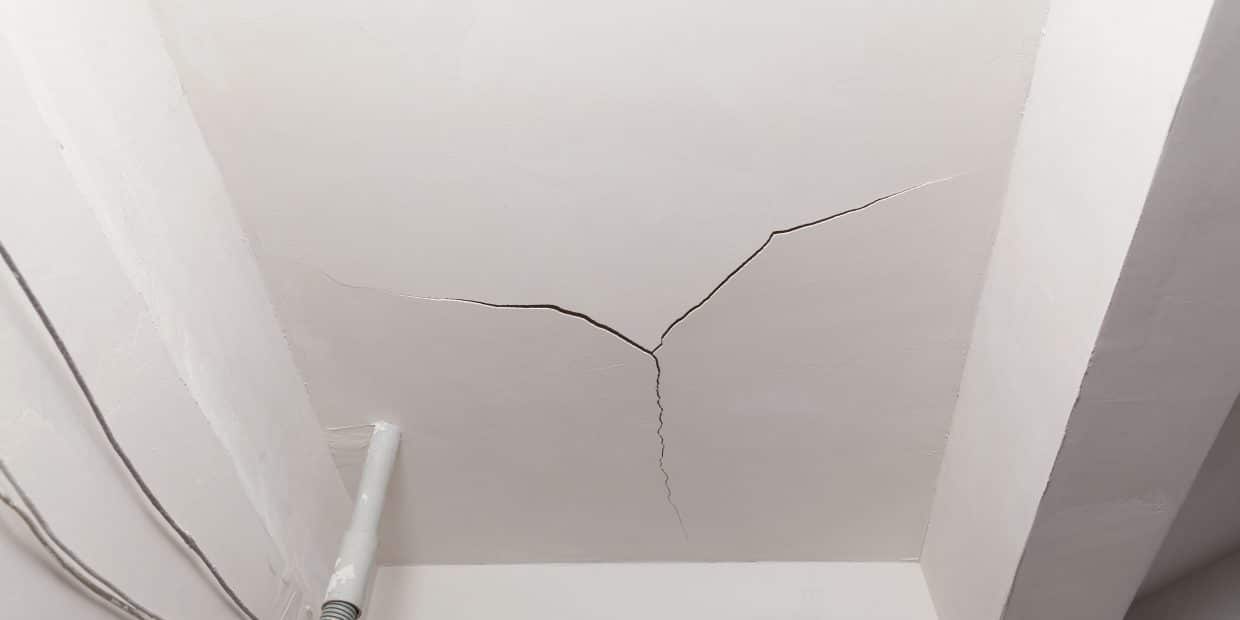
A crack where ceiling meets wall that opens up every fall and quietly closes again by spring is usually not a sign that anything is failing. It is a known, mostly cosmetic behavior called truss uplift, caused by the roof trusses above the ceiling moving with the seasons, not by the house settling or a structural problem underneath.
That does not mean every crack in that exact spot is harmless. The difference is in the pattern: where the crack sits, whether it opens and closes with the weather, and what else is happening nearby. This is specifically about a crack along that seam, not a stain, so if what you are looking at is discoloration instead, water stain on ceiling is the better place to start. Here is how to read the crack itself, and what actually stops it from reopening year after year.
Crack where ceiling meets wall: the movement happening above it
Most houses built since the 1960s have roofs framed with engineered trusses, triangular webs of lumber that span from exterior wall to exterior wall in one piece. The bottom chord of that truss carries the ceiling drywall. The top chords sit up in the open attic, exposed to attic air, while the bottom chord usually ends up buried under insulation and sitting much closer to the conditioned space below. That difference in exposure means the two chords can pick up moisture and temperature at different rates, and wood that is drier shrinks less than wood that has absorbed more humidity.
When that happens, the truss can bow very slightly upward at its center. The two ends stay anchored to the exterior walls, since that is what the truss is actually resting on, so the lift shows up in the middle of the span instead. An interior partition wall sitting underneath that center section was never built to carry any of the roof’s weight. It just holds the ceiling drywall up to meet the truss above it, so when the truss lifts, the ceiling right above that partition lifts with it, and the drywall tears loose from the top of the wall along a thin, straight line. That is the crack you are looking at.
Why it opens every winter and closes by summer
The moisture and temperature gap between the two truss chords is at its widest in the cold months, when a heated house pushes warm, humid air up against the insulated ceiling while the attic above stays cold and dry. That seasonal swing is what drives the truss to arch and the crack to open. As the weather evens out through spring and the attic and the living space settle closer to the same conditions, the truss relaxes back down and the gap at the ceiling narrows, sometimes closing almost completely until the cycle repeats the next winter.
That seasonal rhythm is the single most useful fact for diagnosing the crack. Building inspection references that document truss uplift describe the same pattern: a crack that opens in winter and eases in summer, confined to the ceiling-to-partition joint, is behaving the way uplift behaves. A crack that stays the same width all year, or keeps widening regardless of season, is telling you something else is going on.
Mark it before you decide anything
Pencil a small tick mark at each end of the crack this month, with the date next to it. Check back at the opposite end of the season. A crack that has visibly narrowed or closed is confirming truss uplift on its own, no guesswork needed.
Truss uplift or a structural crack: how to tell them apart
Before you repair anything, spend five minutes reading the crack against the signs below. The two patterns look similar from across the room and are not the same problem.
| What you see | Truss uplift | Worth a second look |
|---|---|---|
| Where it sits | A center, non-load-bearing interior partition, running crosswise to the roof trusses | An exterior wall, a load-bearing wall, or starting from the corner of a door or window |
| How it behaves through the year | Opens in the cold months, narrows or closes by summer | Stays the same width all year, or keeps growing regardless of season |
| Shape of the line | Straight, running along the paint line where wall meets ceiling | Diagonal, stair-stepped through a seam, or wider at one end than the other |
| Company it keeps | Nothing else nearby, doors and windows still open and close normally | A door that sticks, a floor that feels sloped, or matching cracks on an exterior wall or foundation |
| Timing | Recurs every year on roughly the same schedule | Appeared once and has kept spreading, or showed up suddenly with no seasonal pattern |
If the crack is diagonal or keeps company with other signs
A crack that runs diagonally, is wider at one end than the other, or shows up alongside a sticking door, a sloped floor, or matching cracks on the outside of the house is not ordinary truss uplift. The same structural-versus-cosmetic logic that applies here applies to wall cracks too, covered in how to fix cracks in walls, but have it looked at by a structural engineer before you patch anything over it.
What makes it worse, and what to leave alone
A ceiling that is rigidly fastened or glued right up to the top of the partition wall has no room to move with the truss above it, so the drywall itself tears instead of flexing. That is why newer framing keeps ceiling screws and adhesive back from the tops of interior partitions near the center of a truss span, deliberately leaving that strip of drywall unfastened so it can float up and down a fraction of an inch each year without cracking. An older house that was framed before builders routinely did this is simply more likely to show the crack in the first place.
It also explains why a crack like this keeps coming back after a repair that fights the movement instead of allowing for it. Taping the seam tight and burying it under a hard, fully bonded coat of compound re-creates the same rigid connection that cracked in the first place, so the next winter’s uplift just reopens it along the same line, sometimes popping the new tape loose in the process. A seam that splits for an unrelated reason, with no seasonal pattern, is usually the ordinary tape failure covered in drywall seam crack rather than uplift, and it gets repaired differently.

The fix that actually holds: let the ceiling float
The repair that lasts is the one that lets the seasonal movement keep happening instead of trying to pin it shut. For a plain hairline crack with the drywall itself still intact, that means replacing whatever is in the seam now with a flexible, paintable acrylic latex caulk instead of a hard-setting compound. Caulk can compress in winter and stretch back out in summer along with the gap; dried joint compound cannot, which is exactly why a rigid patch splits again on schedule.
-
Clean out the old seam
Run a utility knife along the crack to scrape out loose paint, old caulk, or crumbling compound so the new caulk bonds to solid material on both sides.
-
Load a flexible, paintable caulk
An acrylic latex caulk rated for interior trim and drywall, not a rigid spackle or a hard-setting compound, is what lets the joint keep moving.
-
Run a thin, even bead into the seam
Smooth it with a wet finger or a caulk tool so it sits just below the surrounding surface rather than standing proud as a ridge.
-
Let it cure fully before painting
Most interior acrylic latex caulks want roughly a day to skin over and cure enough to take paint without wrinkling.
-
Watch it through one full winter
A properly floated joint should flex with the season instead of splitting. If it still cracks after a full cycle, the gap is probably wider than a bead of caulk can absorb, and the seam needs to be taped loosely instead.
If the seam has already torn through the drywall paper rather than just the paint and caulk on top, a caulk bead alone will not hold it. That calls for the sink, tape, and float method instead: set any popped nails or screws back down, strip the old cracked tape right along the seam, then bed new tape loosely rather than pulling it tight into the corner, so it can bow slightly with the ceiling instead of locking it rigid. Feather the compound out several inches on each side using the same thin, setting-type approach covered in skim coating a ceiling, since gravity makes a thick overhead coat sag before it sets. If the hole or tear is bigger than a seam split, treat it as an overhead patch using the methods in how to patch a small hole in the ceiling instead.
Crown molding is the other real fix, and it is why trim carpenters reach for it specifically at this joint in truss-framed houses. Molding fastened to only one surface, usually the wall, while resting against but not nailed into the ceiling, hides the seam completely and lets the ceiling keep moving behind it without ever showing a line. That is a legitimate long-term repair, not just a way to cover up a problem nobody fixed.
Crack where ceiling meets wall: when it means something else
Most of these cracks are exactly what this guide describes and nothing more. A smaller number are a sign to stop patching and get someone else to look. Treat it as worth a second opinion, not a caulk gun, if any of these apply:
- The crack keeps widening year over year instead of cycling open and shut with the seasons
- A door or window near the crack has started sticking or no longer latches the way it used to
- The floor near that wall feels sloped or noticeably uneven underfoot
- Matching cracks have shown up on an exterior wall, brick veneer, or the foundation
- The house is new, settling cracks are spreading well beyond this one joint, and it has not been through a full seasonal cycle yet
A ceiling that is visibly sagging in the middle, rather than just cracked along one straight seam, usually points to a different cause altogether, covered in how to fix a sagging ceiling. That is worth ruling out before you assume every ceiling problem in the house is the same truss movement described here.
Common questions
Is a crack where the ceiling meets the wall dangerous?
Usually not. Truss uplift is a known, mostly cosmetic side effect of how roof trusses respond to seasonal moisture and temperature, not a sign of a failing roof or a failing wall. It is worth a second look only when it is paired with the other signs covered above.
Why does the crack only show up in winter?
The gap between a truss’s top and bottom chords is widest when the temperature and humidity difference between a heated house and a cold attic is largest, which is the coldest part of the year. As the attic and the living space move closer together through spring, the truss relaxes and the crack narrows or closes.
Will drywall tape alone fix it for good?
Not if it is pulled tight and buried under a hard, fully bonded coat of compound. That recreates the rigid connection that cracked in the first place, so it tends to reopen the next winter. Tape bedded loosely, or a flexible caulk joint instead of tape, holds up far better because it can move with the seasonal gap.
Can I just paint over the crack instead of repairing it?
Paint has a little give, but a hairline crack usually telegraphs straight back through it within a season or two. Caulking the seam first gives the paint film something underneath it that can actually stretch with the movement, instead of asking the paint to do that job on its own.
Does truss uplift mean my roof trusses are failing?
No. It is a well-documented, common behavior of engineered roof trusses responding to moisture and temperature differences between their top and bottom chords, not a sign of a design flaw or an installation defect.
How do I know if this is new-construction settling instead?
Settling cracks in a newly built house often show up at several seams in the first year or two and usually stop on their own once the lumber finishes drying out. Truss uplift keeps recurring on a seasonal clock, specifically at the ceiling-to-partition joint, year after year, long after a new house has finished settling.
Does crown molding actually fix it, or just hide it?
When it is fastened to only one surface, it is a real fix, not just cover-up. The ceiling keeps moving behind the molding without ever showing a visible line, which is a different thing from rigidly bridging the gap the way a fully bonded tape joint does.
Crack where ceiling meets wall, the short version
A straight hairline crack at a center interior wall that opens in winter and eases by summer is truss uplift, not damage. Skip the rigid patch, float the joint with a flexible caulk or a loosely bedded tape instead, and give it one season to prove it holds. A crack that keeps growing, runs diagonally, or shows up alongside a sticking door or a sloped floor is a different problem, and that one is worth a structural engineer rather than a caulk gun. For other ceiling-specific problems, the full set of guides is collected under ceilings, and the general drywall-repair playbook, including ordinary wall cracks, lives under drywall repair.